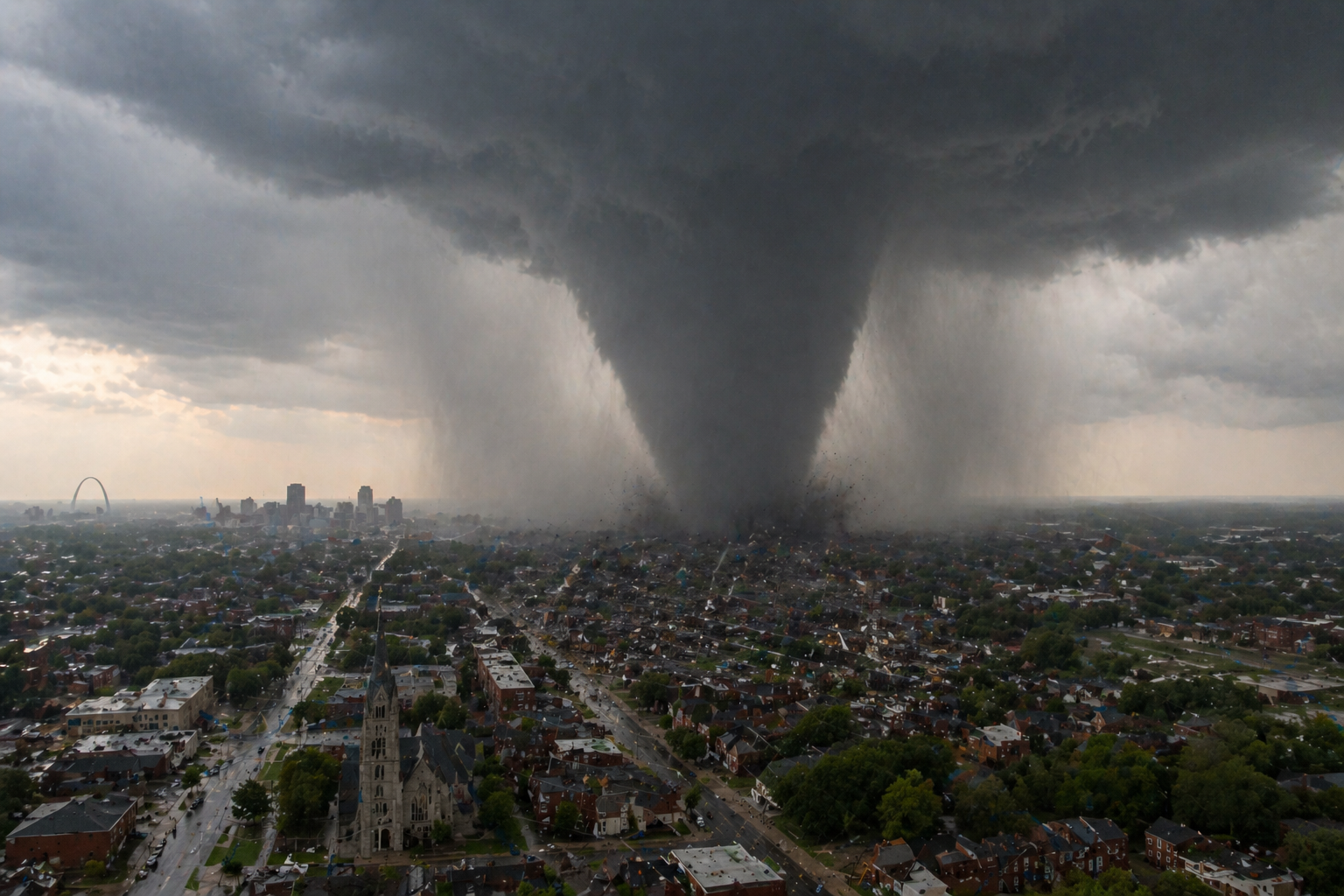

I often use Wikipedia to start down rabbit holes on the internet. I type in a subject, skim the facts, maybe click a few rabbit-hole links. Then I move on with my life. Today, I transformed from a reader to a contributor when I added a short paragraph to the Wikipedia article about the 2025 St. Louis tornado. It may not sound dramatic, but for me it felt like participating in the public record.
The tornado was one of the most significant storms in recent St. Louis history. It carved through neighborhoods across the city, leaving destruction, heartbreak, and a long recovery process behind it that is still going on a year later. As I read the article, I noticed something missing: there was a discussion of the tornado’s path and damage, but there was no clear, centralized listing of the neighborhoods affected. This was a big deal to me.
My family and I were personally impacted by the tornado. My neighborhood caught the edge of it, and my house was moderately damaged. Around the corner from me, the damage was more severe. Yet, my neighborhood was missing from the paragraphs that followed the path of the tornado.
St. Louis is not just one generic place. It is a patchwork of communities, each with its own identity, history, and culture. Saying a tornado hit “St. Louis” is technically true, but incomplete. It matters whether it struck Fountain Park, The Ville, Greater Ville, Central West End, Penrose, O’Fallon, or North Riverfront. Those names tell residents something real. They tell us who was impacted, what communities are recovering, and where help may still be needed.
So I added a paragraph listing the neighborhoods damaged by the tornado: Wydown Skinker, Forest Park, Skinker-DeBaliviere, DeBaliviere Place, Central West End, West End, Visitation Park, Academy, Fountain Park, Lewis Place, Vandeventer, Hamilton Heights, Wells Goodfellow, Kingsway West, Kingsway East, Greater Ville, The Ville, Penrose, O’Fallon, Fairground Park, Bellefontaine Cemetery, O’Fallon Park, College Hill, North Riverfront, and Near North Riverfront
That may seem like a small edit, but small edits are often how knowledge improves. Wikipedia is built less by grand gestures and more by thousands of people noticing missing context and filling it in. A sentence here. A citation there. A correction to spelling. A date fixed. Piece by piece, the public archive gets stronger and the knowledge more complete and iron-clad.
What struck me most was how empowering the process felt. So much of modern life is passive. We scroll, consume, react, and complain. But editing Wikipedia is active. I was not just taking information. I was helping shape how information is presented to millions of people. That is a different feeling entirely. I felt… proud. I felt like I’ve accomplished something.
It may seem trivial, but to me it matters. Someone in another state may read that article and see a list of unfamiliar names. But to someone from St. Louis, those names mean schools, churches, corner stores, parks, family homes, and memories. They represent real people, not just map coordinates.
Plus, I felt my contribution was important because there is no adequate list of affected neighborhoods available, and people may need this for insurance purposes.
There is also something democratic about Wikipedia at its best. You do not need to be a celebrity, a professor, or a corporate media outlet to improve an article. If you have accurate information, good intent, and respect for standards, you can contribute.
My edit was modest. I did not rewrite history or uncover hidden facts. I simply made the article more complete and more human. But maybe that is enough.
Sometimes civic participation is voting. Sometimes it is volunteering. And sometimes it is adding a paragraph so the world remembers exactly which neighborhoods were hit.