Tag: David duke

  • Racism Did Not Disappear. It Learned to Dress Better.

    Racism Did Not Disappear. It Learned to Dress Better.

    I have shared videos of Ku Klux Klan members and other racists explaining what they believe on my Facebook page. What interests me is how familiar some of those beliefs sound once you look past the robes, the slurs, and the willingness to say the quiet part out loud.

    The KKK does not represent every American. Nor should one town, one interview, or one group stand in for the whole country.
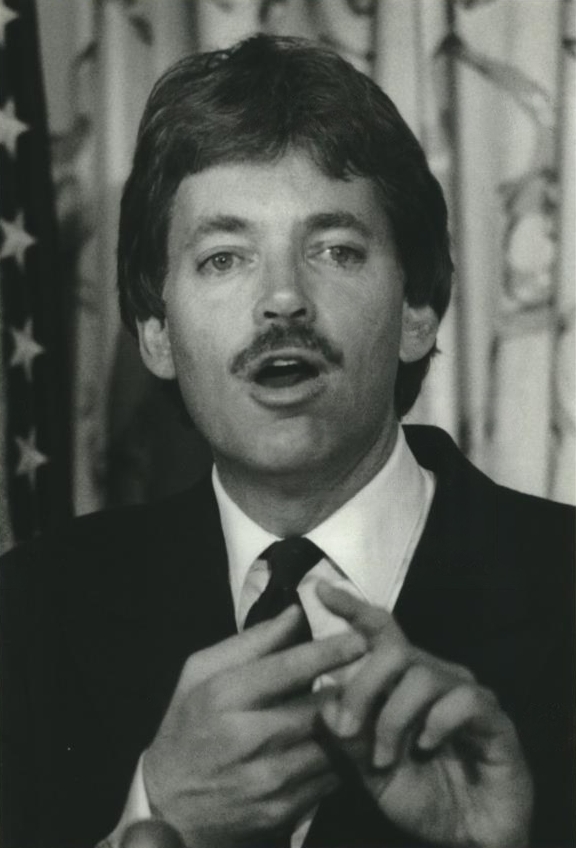
    A photo of David Duke from 1989.
    David Duke wanted to make the KKK more acceptable to theAmerican public by presenting a more polished and white collar image of the group.

    But that does not mean the ideas expressed in those videos exist only among people who openly identify as racists.

    The belief that Black people are inherently less capable, less civilized, more dangerous, or less deserving can appear in different forms and degrees. Someone can reject the Klan and still accept assumptions that have a great deal in common with its worldview.

    That is what I want people to examine.

    For generations, racism helped justify conquest, enslavement, colonial exploitation, and exclusion. People dressed those justifications up as science, religion, common sense, and concern for civilization.

    The cruelty came with an explanation. The explanation made the cruelty easier to defend.

    We still need to pay attention to that process.

    Racism can become so familiar that people stop recognizing it unless it appears in its most extreme form. They know a hood and a burning cross when they see them. They know an explicit slur when they hear one.

    But a polished commentator making insinuations about Black intelligence, criminality, or belonging? Suddenly, we are supposed to consider whether that person is simply a misunderstood truth-teller.

    Apparently, racism becomes harder to recognize when the speaker has a studio, a suit, and a respectable vocabulary.

    A photo of Nick Fuentes.
    Nick Fuentes is literally a self-professed Nazi (or Nazi sympathizer) who can get away with much of what he says, and was invited to Donald Trump’s mansion for dinner because he isn’t seen in the uniform of White supremacy.

    I am tired of the idea that avoiding the N-word automatically makes an argument free of racism.

    What is the argument asking us to believe? How is the evidence being used? What context has been left out? Is a problem being examined, or is an entire people being assigned a negative character?

    Those questions matter more than whether the speaker remembered to avoid a slur.

    Statistics deserve scrutiny too. A number can be accurate while the story built around it is misleading. Selective comparisons, missing context, and sweeping conclusions can turn data into a tool for reinforcing prejudice.

    If someone uses a statistic to suggest that Black people are inherently defective, the presence of a number does not make that suggestion objective.

    A spreadsheet does not wash racism out of an argument.
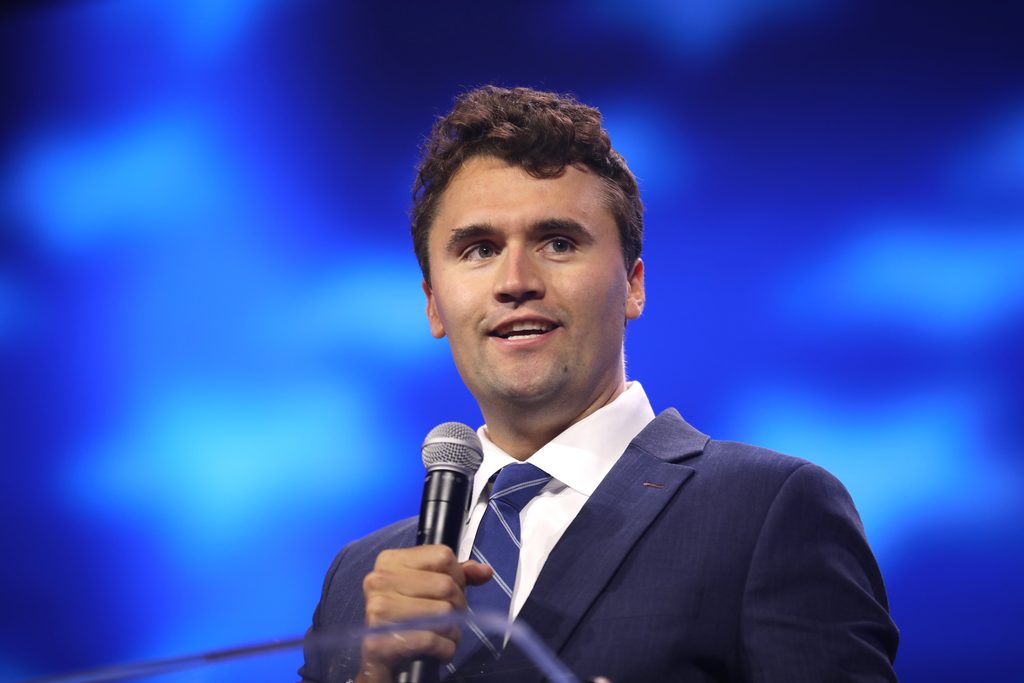
    A photo of Charlie Kirk holding a microphone.
    Charlie Kirk’s “truth” was nothing more than racism using cherry-picked and out-of-context statistics. These are often quoted on his podcast and while debating undergrad students on college campuses.

    One of the things I wanted people to notice in those videos was the date.

    When were these people saying these things? When were the incidents happening? How long after the major civil-rights victories were communities still facing intimidation, exclusion, and openly racist hostility?

    Too many people talk as though the Civil Rights Act of 1964 and the Voting Rights Act of 1965 closed the book on racism.

    Those laws were extremely important. But passing a law did not instantly change everyone’s beliefs, dismantle every discriminatory practice, or erase the advantages accumulated under the old arrangements.

    Some attitudes changed. Some people changed. Others learned to conceal what they believed or express it in language that gave them plausible deniability.

    We should recognize progress without pretending that it finished the job.

    That is also why I keep returning to the contrast between how Barack Obama and Donald Trump have been judged.

    I am not arguing that every criticism of Obama was racist. I criticized him myself. His policies and decisions deserve examination like those of any other president.

    But I watched people demand that he be endlessly calm, polished, articulate, restrained, and reassuring—and still treat him as illegitimate, threatening, or fundamentally out of place.

    He could meet their stated standards and still fail the test.

    Then I watched some of those same people celebrate Trump’s belligerence, insults, and disregard for restraint as signs of strength.

    Conduct they would have treated as disqualifying in Obama became proof that Trump was authentic and willing to fight.
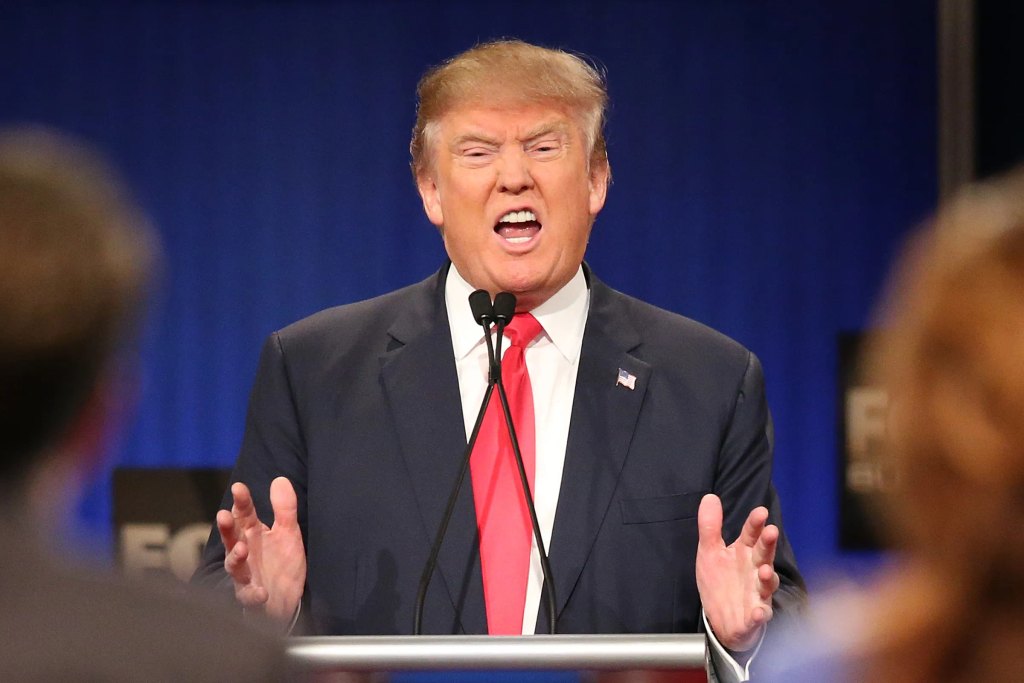
    A picture of Donald Trump at a podium looking angry.
    Donald Trump can get away with egregious behavior that Obama is not able to get away with. Obama had to mostly remain stoic during his presidency, while Trump can be angry and belligerent.

    What changed—the standard, or the person being judged?

    That question deserves more than a reflexive accusation that I am “making everything about race.”

    I do not need to claim that every measure of the country’s condition was better under Obama to make this point. Presidents should be judged on evidence, and different outcomes require different comparisons.

    My concern here is the permission some people grant one leader while demanding constant reassurance from another.

    If restraint is essential to presidential character, it should matter when Trump lacks it. If inflammatory rhetoric is dangerous, it should not become admirable simply because the speaker is someone you support.

    And if intelligence, preparation, and dignity are the standards, meeting them should count regardless of the president’s race.

    Too often, that consistency disappears.

    This is why the openly racist videos matter to me. They make certain assumptions easier to hear. Once we recognize those assumptions in their bluntest form, we should be willing to examine where else they appear.
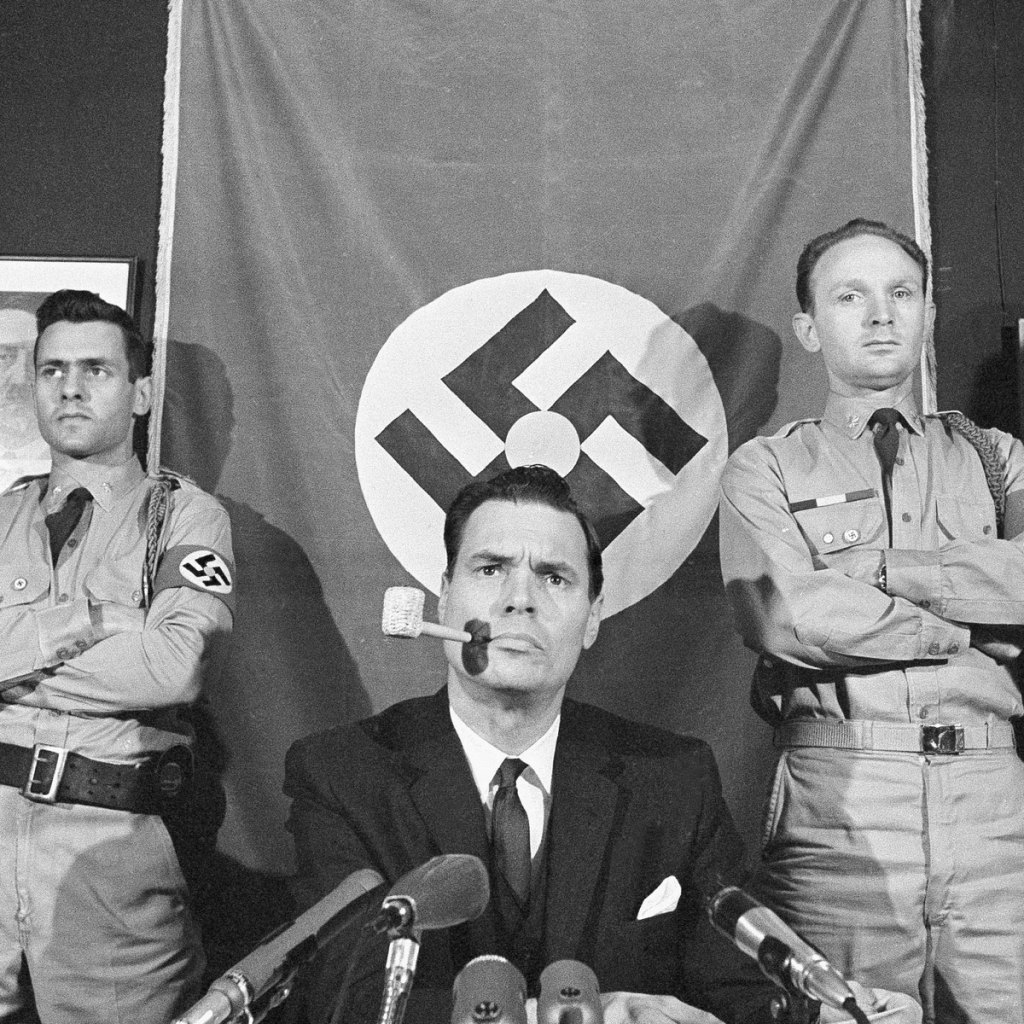
    A picture of George Lincoln Rockwell wearing a suit and tie while flanked by two White men wearing Nazi uniforms. A Nazi flag hangs behind them.
    George Lincoln Rockwell was the founder of the American Nazi Party (ANP). He was a very articulate man who attended an Ivy League University (Brown University). Often, he would dress in Nazi uniforms but he would often dress in a suit and speak while smoking his signature pipe. Often, his message wasn’t necessarily antagonistic or violent, but they were exclusionary and racist.

    The delivery may be smoother. The speaker may deny any prejudice. The audience may insist that it is all about policy, statistics, or “telling the truth.”

    But we still have to examine the substance.

    Racism does not need a hood, a slur, or a confession to operate.

    And refusing to recognize it until someone supplies all three gives far too many people permission to keep doing it.
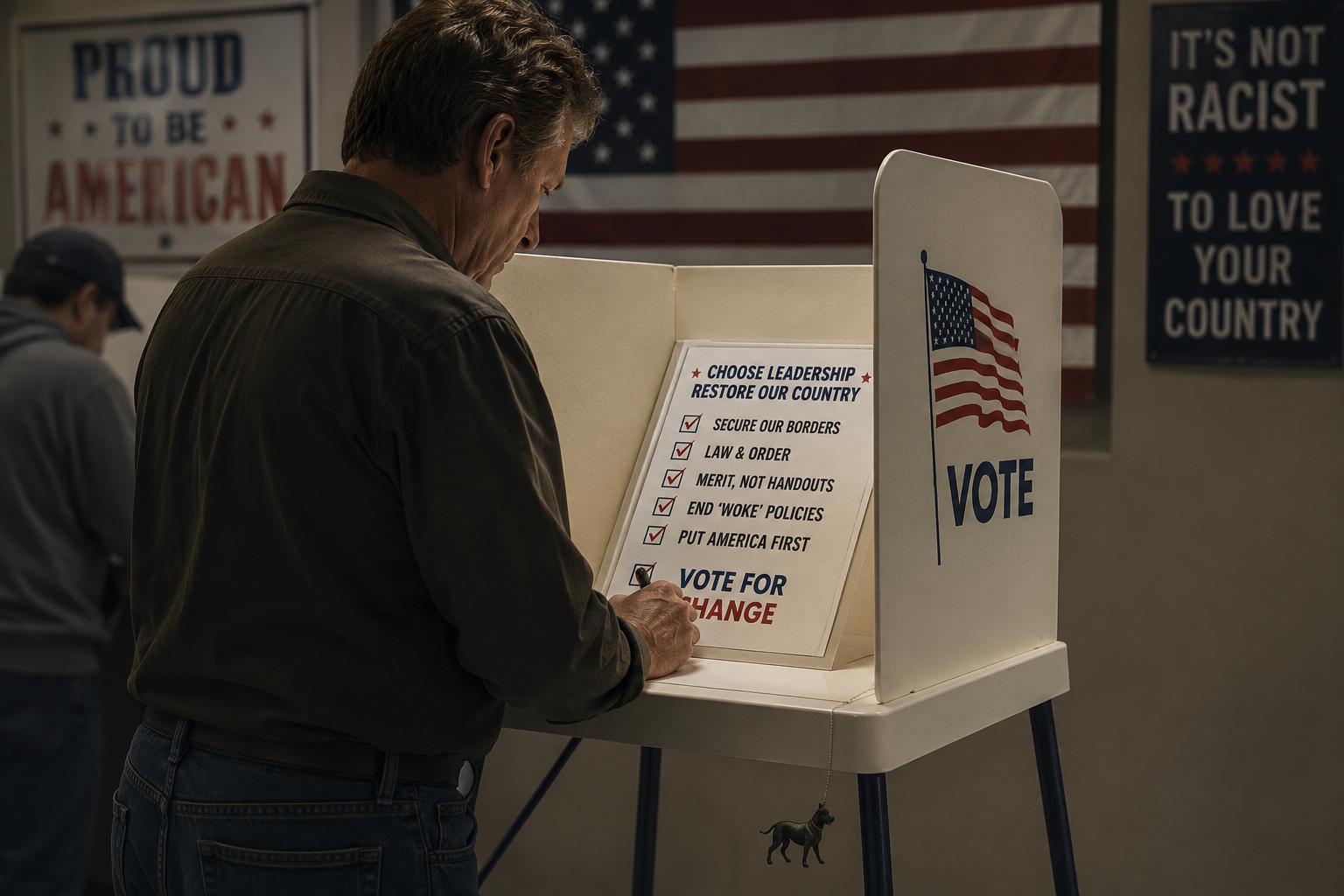
  • America’s Racial Problem Is Not in the Past, And I’m Tired of People Pretending It Is

    America’s Racial Problem Is Not in the Past, And I’m Tired of People Pretending It Is

    One of the most frustrating parts of talking about racism in America is how often people act as if it is either exaggerated, isolated, or long behind us. Every time I say that most white Americans have, at minimum, participated in or benefited from racist systems and behavior, there is always a predictable backlash. The conversation shifts from the reality of racism to defensive utterances, including people charging me with racism, exaggerated claims of Black culpability in slavery, sloppy attempts to “both-sides” racism, and arguing that racism was a past reality that black people need to get over.

    But history (and the present) tell a very different story, and I’m not pulling that conclusion out of thin air.

    I’m looking at history, voting patterns, where people choose to live, how they react when Black people move into their neighborhoods, what they tolerate politically, and what I have personally watched happen over and over again in this country.

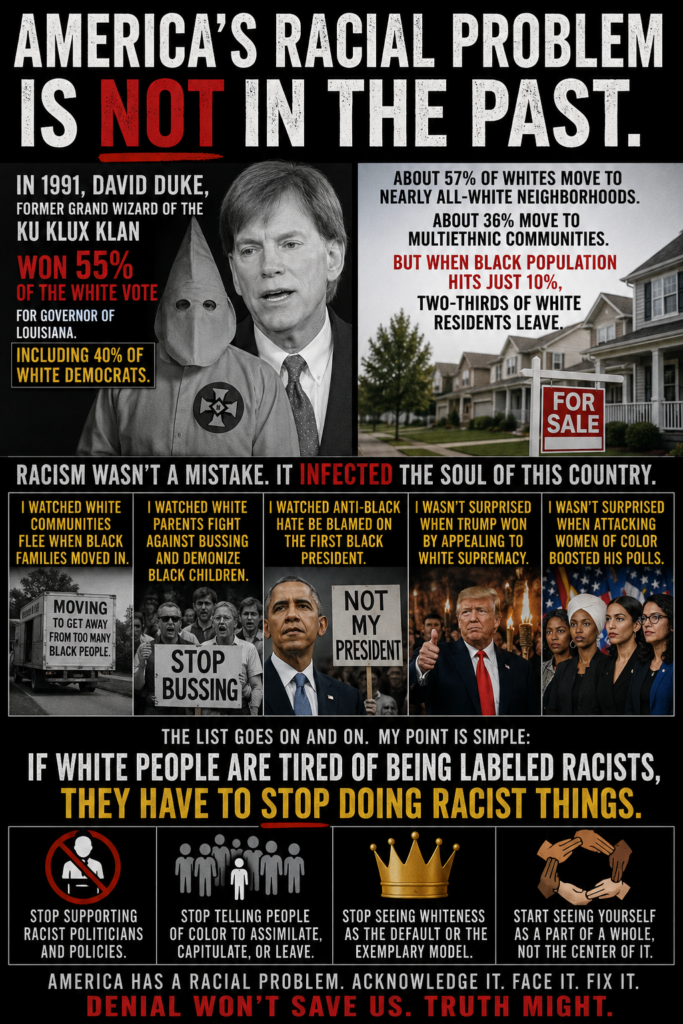
    In 1991, David Duke, a former Grand Wizard of the Ku Klux Klan, won 55% of the white vote when he ran for governor of Louisiana. Let that sink in. A man whose public identity was openly tied to white supremacy won a majority of white voters, including 40% of white Democrats. That was not the distant 1800s. That was the early 1990s.

    And this pattern is not an isolated one. Since the passage of the Civil Rights Act of 1964 and the Voting Rights Act of 1965, Democratic presidential candidates have consistently struggled to win the white vote. Even in 1976, when Jimmy Carter performed unusually well among white voters, Gerald Ford still won them overall. That should force us to ask uncomfortable questions about what racial backlash has looked like in American politics for the last half-century.

    These are not random or meaningless occurances. And it is not just “economic anxiety.” This is racism built into the bloodstream of American politics and manifest through voting decisions and patterns.

    The same dynamic has shaped where people live, where they send their children to school, and how they define “good” neighborhoods and “bad” neighborhoods. White flight did not happen by accident. It was not simply about “better schools” or “quality of life.”

    For decades, study after study (and plain old lived reality) has shown that white people love to talk about diversity until Black people actually start moving in next door. White families will say they want “good communities” and “nice neighborhoods,” but once a place becomes “too Black” (usually with a Black population at or above 10%), all of a sudden the moving trucks come out and the “For Sale” signs start multiplying like weeds.

    In community after community, once Black families moved in, white families moved out. I have seen it with my own eyes. Entire white communities expanded further and further outward, into what had once been farmland, not because they were escaping crime or collapse, but because too many Black people had moved nearby.

    And it did not matter if those Black families were educated, professional, stable, or middle class. Their Blackness alone was enough for those white families to flee further into the suburbs.

    We want to act like racism was just Bull Connor, George Wallace, fire hoses, and white robes. We want to tell ourselves that racism was a regrettable chapter that “we overcame,” and now the only real racists are a few cartoonishly evil people at the margins.

    That is a lie.

    Racism in America was never just about the loudest extremists. It has always depended on ordinary white people making racist choices in ordinary ways: where they live, who they vote for, what schools they support, what fears they indulge, what policies they excuse, and what kind of treatment of Black people they are willing to rationalize.

    I saw white parents rage against school bussing while talking about Black children as if they were grave threats. I saw anti-Black hostility dressed up as “concern” and “standards.” I saw white resentment toward Barack Obama, a man raised largely by white family members, treated as if he were some dangerous racial radical simply for existing in the White House while Black.

    So no, I was not surprised when Donald Trump rose to power by openly winking at white grievance and white nationalism. I was not surprised when racist attacks on women of color energized parts of his base. I have seen this movie before.

    A lot of white Americans want to be absolved without being examined.

    They want credit for not wearing a hood while still supporting racist politicians, racist policies, racist housing patterns, racist school systems, and racist cultural assumptions.

    That’s not how this works.

    America’s racial problem has never been confined to a handful of extremists in white robes. That is the lie people tell themselves so they do not have to examine the everyday racism embedded in housing, education, politics, media, and social life. Racism in America has never just been about “bad people.” It has been about a society that trained millions of ordinary people to see whiteness as the norm, the standard, and the default.

    And that is the real issue.

    If white Americans are tired of being associated with racism, then the answer is not to get offended when people point it out. The answer is to stop supporting racist policies, racist politicians, racist assumptions, and racist social arrangements. Stop demanding that people of color quietly assimilate into a system built to marginalize them. Stop treating whiteness as the universal model of what is “normal,” “civilized,” or “American.”

    Because America’s racial problem is not ancient history. It is not dead. And pretending otherwise is part of the problem.