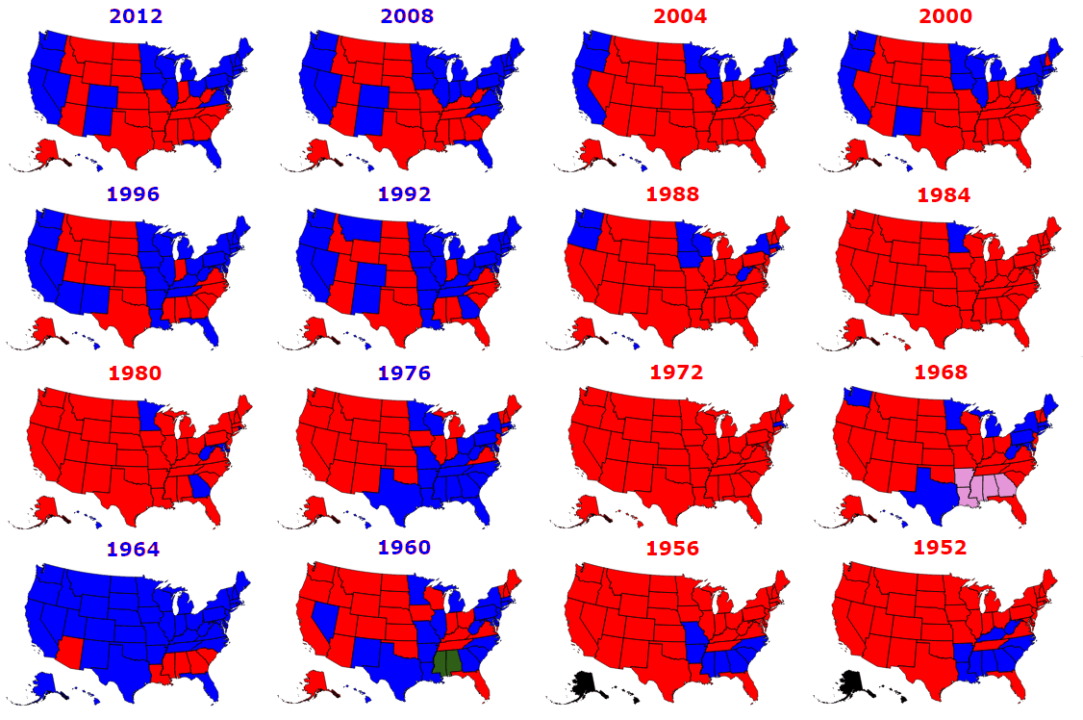
One of the most persistent claims in modern political debates is that the Democratic and Republican parties have remained essentially the same throughout American history. According to this argument, the political coalitions and ideologies of the nineteenth century supposedly still define the parties today.
This claim ignores one of the most well-documented developments in American political history: the gradual ideological realignment of the two major parties from the late nineteenth century through the late twentieth century.
Following the Civil War, the Republican Party was widely associated with the Union victory and the abolition of slavery. During Reconstruction, Republicans supported many early civil rights measures intended to protect the rights of newly freed Black Americans.
However, that political commitment weakened dramatically after the Compromise of 1877, which effectively ended Reconstruction. Federal enforcement of civil rights protections collapsed, and white supremacist governments regained control across much of the South.
For decades afterward, Southern politics was dominated by segregationist Democratic politicians often referred to as Dixiecrats. These politicians supported Jim Crow laws, racial segregation, and policies designed to disenfranchise Black voters.
But American political coalitions were not static.
Beginning in the mid-twentieth century, particularly during the Civil Rights Movement of the 1950s and 1960s, many white Southern conservatives began shifting their political allegiance. As national Democratic leaders increasingly supported civil rights legislation, large numbers of segregationist voters and politicians gradually moved toward the Republican Party.
This transition did not happen overnight. It unfolded over several decades, from the 1960s through the 1980s and even into the early 1990s. Historians and political scientists commonly refer to this process as political realignment.
The shift can be seen in electoral patterns across the South. States that had reliably voted for Democratic presidential candidates for nearly a century increasingly began supporting Republican candidates. Conservative Southern politicians who once identified as Democrats also began switching parties.
Despite this well-documented transformation, some modern political commentators attempt to deny that any realignment occurred. Instead, they argue that the parties remain essentially unchanged and that historical responsibility for segregationist politics belongs exclusively to one party.
But historical evidence tells a more complicated story.
The ideological divide in American politics has long revolved less around party labels and more around competing views about civil rights, federal power, and social hierarchy. Over time, the political coalitions representing those views have shifted between parties.
This is why discussions of American political history require careful attention to ideology, region, and historical context, rather than relying solely on party labels.
Reducing the history of American civil rights struggles to simple partisan talking points obscures the reality of how political coalitions evolve. Understanding that evolution is essential for understanding the political landscape of the United States today.