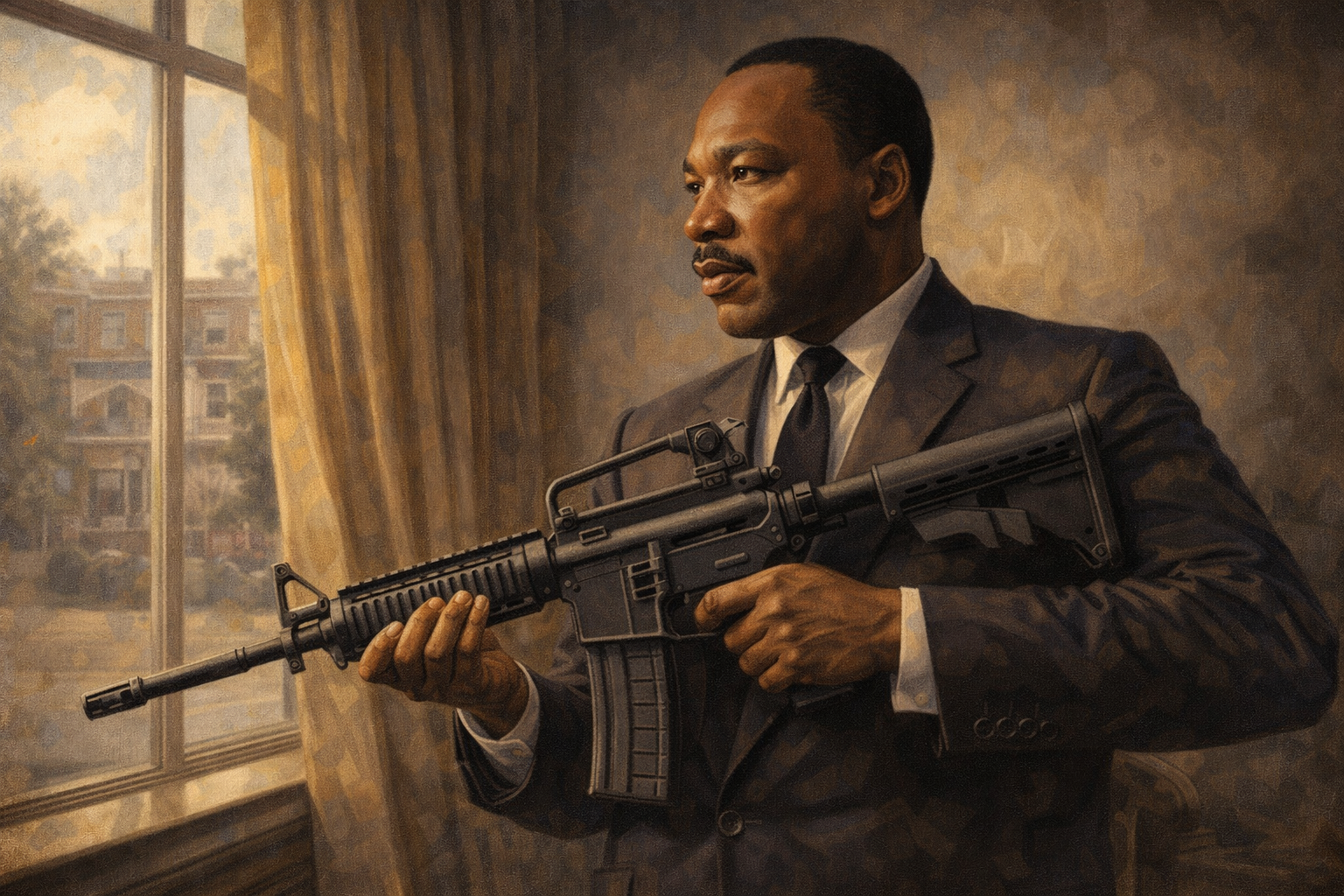
Every January, around the time of Martin Luther King Jr. Day, a familiar political ritual begins.
Public figures across the political spectrum invoke King’s name in support of their own positions. Liberals quote him. Conservatives quote him. Moderates quote him. Everyone suddenly seems convinced that Dr. King would agree with them if he were alive today.
In many cases, these attempts say more about the people invoking King than about King himself.
One of the more curious examples in recent years has been the claim that Dr. King would have opposed modern gun control laws because he owned firearms.
At first glance, this argument might sound plausible. It is true that King once applied for a permit to carry a handgun after his home was bombed during the Montgomery Bus Boycott. In the violent atmosphere of the Jim Crow South, many civil rights leaders faced credible threats to their lives.
But isolating that fact while ignoring King’s broader philosophy creates a deeply misleading picture.
Dr. King was one of the most committed advocates of nonviolence in modern history. His entire political and moral philosophy centered on the belief that violence ultimately corrupts both individuals and societies. Throughout his career, he repeatedly emphasized that the civil rights movement must reject violence—even in the face of brutal repression.
More importantly, King’s political views extended far beyond the narrow civil rights narrative that is often presented today.
In the final years of his life, King increasingly criticized economic inequality, militarism, and American foreign policy. He spoke openly about the need for a radical restructuring of American society and argued that poverty, racism, and war were interconnected problems.
He supported strong labor rights, called for major government programs to address poverty, and spoke favorably about forms of democratic socialism.
In other words, the historical Dr. King was far more politically complex and far more radical than the sanitized figure often presented in modern political debates.
Projecting modern ideological battles onto King may be tempting, but it risks distorting the historical record.
Rather than imagining the version of King we wish existed, it might be more productive to engage honestly with the one who actually did.