Tag: elections

  • Casual Political Onlookers, Full-Time Experts

    Casual Political Onlookers, Full-Time Experts

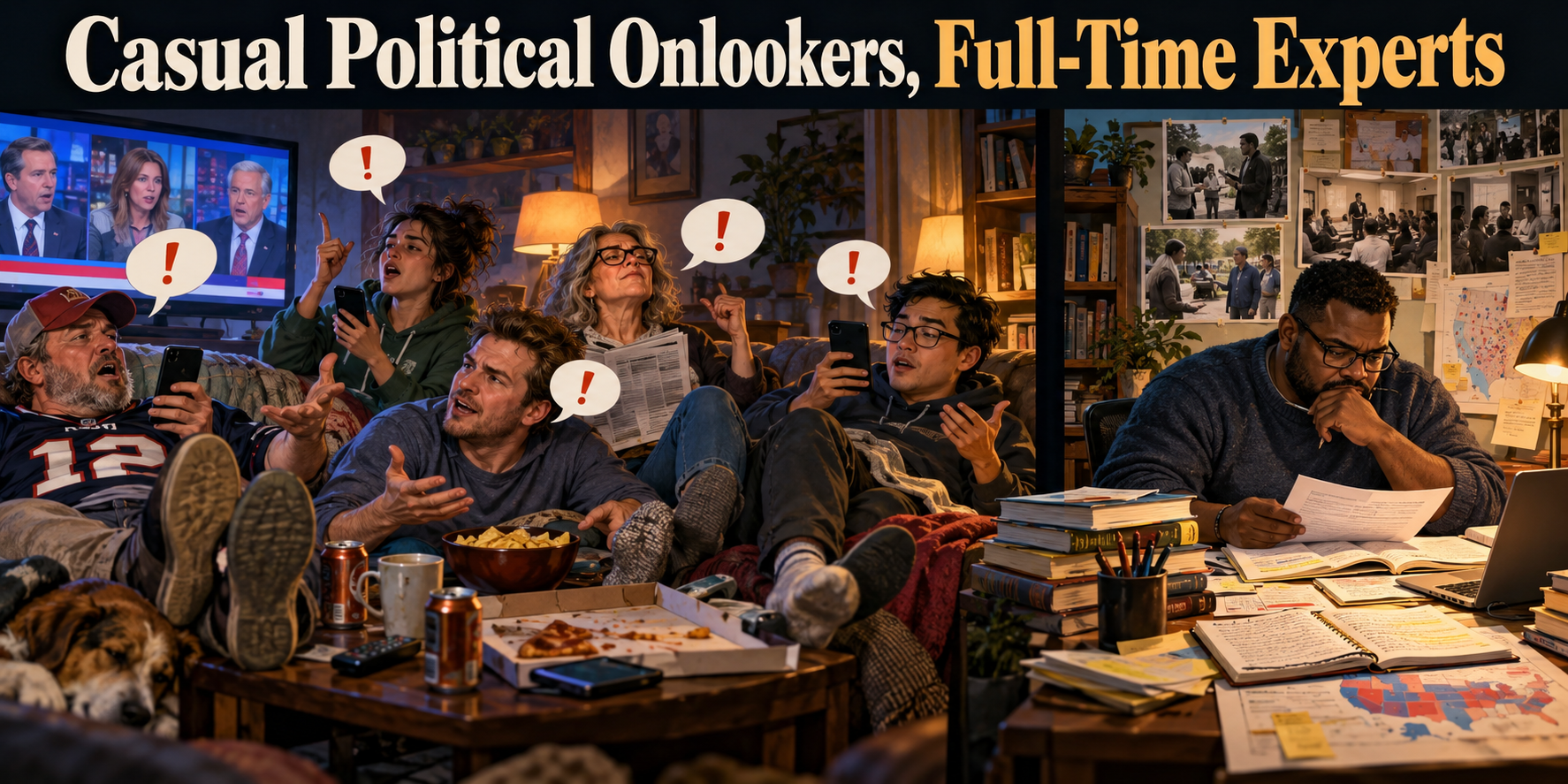
    One thing I’ve learned over the years is that most people are casual political onlookers who pretend to be experts. They pay attention around election time, pick up a few talking points, and suddenly think they understand the electorate better than anyone else.

    People like me geek out over politics the way other people geek out over sports, Dungeons & Dragons, and high-fantasy book series. I haven’t been a casual onlooker for many years. I eat, sleep, drink, shit, and breathe politics. Since I was a child, I’ve felt that staying informed was part of my civic duty. That means paying attention to who is running, why they are running, and what they actually stand for.

    I shouldn’t be special in this way. For a long time, I assumed that plenty of people approached politics the same way I did. A peace rally and demonstration I attended in 2003 helped shake me out of that assumption.

    Since then, I’ve watched people repeat bullshit talking points from the major cable news networks over and over again until they mistake repetition for knowledge. They believe what they’ve been fed, then treat anyone who questions it as politically naïve.

    Meanwhile, too many of these supposed experts have no real feel for working-class and middle-class America. They don’t understand how squeezed people feel, how angry they are, or how tired they’ve become of being told to accept less while the people at the top keep getting more.

    The certainty that Bernie Sanders is “unelectable” reminds me of the same certainty I heard about Barack Obama before he started winning primaries. People swore up and down that America wasn’t ready for a Black president. They treated that assumption as a fact.

    I disagreed.

    When I was tapped to work with Obama’s campaign in the summer of 2007, I committed to it. That wasn’t because I thought Obama was a messiah or because I belonged to some political cult. Dennis Kucinich was my first choice, based on principles. But I also understood that Kucinich had a snowball’s chance in hell of winning, while Obama had the political talent to pull it off.

    I could distinguish between the candidate whose positions I preferred and the candidate whose ability to win I believed people were underestimating. Apparently, that distinction is difficult for people who assume that supporting a campaign means worshipping the candidate.

    What frustrates me is how often political conventional wisdom gets passed off as expertise. People inside the same circles repeat the same assumptions, reinforce one another, and then act shocked when voters do something they didn’t expect.

    At some point, we have to ask whether these people understand the electorate or just understand each other.

    Too many political commentators, party insiders, and casual observers are living in a bubble. They underestimate the anger of American workers while overestimating the authority of the people who tell them what is politically possible.

    We saw that in 2016. I hoped that election would force the media, the Democratic Party, and the people who followed their predictions to examine what they had missed.

    Instead, too many went right back to the same assumptions and the same dismissive bullshit.

    Working people are telling us how angry they are. They are telling us how squeezed they feel. If our response is to lecture them about what they should accept, we shouldn’t be surprised when they stop listening to us.

    Pay attention. The people repeating conventional wisdom the loudest are not automatically the people who understand what is happening.
  • Why Tangible Benefits Matter in Politics

    Why Tangible Benefits Matter in Politics

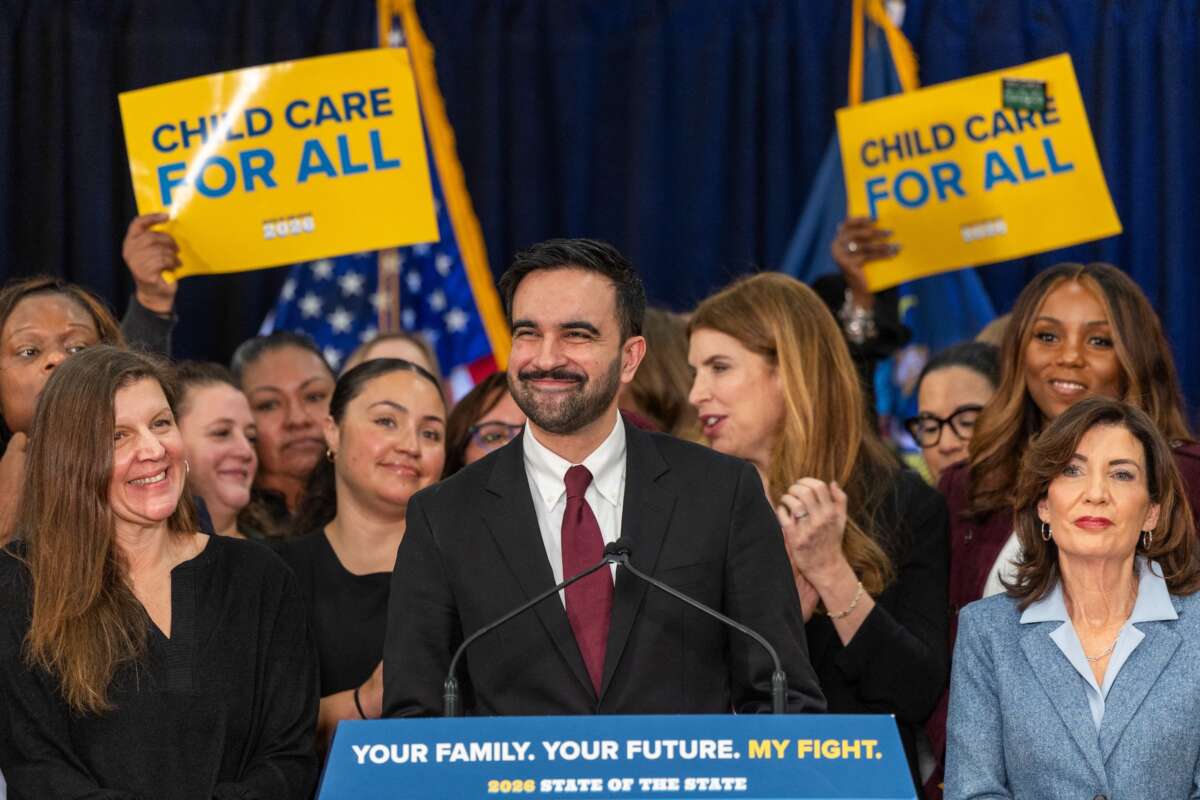
    The often-overlooked reality of American politics is that policy messaging often matters less to voters than tangible benefits they can see and feel in their everyday lives. This is something that the professional pundit class, political consultants, and many political analysts often miss.

    During the COVID-19 pandemic, stimulus checks were sent to millions of Americans. Although the checks were authorized through legislation passed by Congress, many people associate them directly with Donald Trump because his administration ensured his name appeared on them.

    Symbolism matters in politics.

    For many struggling households, those payments were not abstract policy decisions. They were rent money, grocery money, or the difference between making it through the month and falling further behind.

    This illustrates a broader lesson that many political strategists understand but that some policymakers still underestimate: voters tend to reward leaders who appear to deliver direct, tangible benefits.

    In contrast, the Democratic Party has often struggled to communicate its policy achievements in ways that feel immediate and visible to ordinary voters.

    The Biden administration did authorize $1,400 stimulus payments and temporarily expanded the Child Tax Credit, which significantly reduced child poverty while it was in place. Yet those policies were not framed with the same kind of direct political branding that many voters remember from the previous administration.

    Even more importantly, the expanded Child Tax Credit was allowed to expire after only one year, despite its measurable impact.

    For many voters, particularly those in economically struggling communities, this reinforces the perception that political leaders make promises but rarely sustain meaningful material improvements.

    That perception fuels cynicism and political apathy.

    When people feel that no political party consistently delivers real change, they often become disengaged or focus only on immediate personal survival rather than broader political issues. Concerns about systemic racism, economic inequality, or long-term policy debates can feel distant compared to the daily struggle of paying bills or putting food on the table.

    This dynamic also shapes how people interpret political messaging. When leaders speak about justice, reform, or social change without delivering visible economic improvements, the message can ring hollow to those who are struggling the most.

    None of these excuses the dangers posed by demagogic politics or authoritarian rhetoric. But it does highlight an important political truth: tangible benefits often carry more weight with voters than symbolic gestures and ideological arguments.

    If political leaders want lasting support from working-class communities, they cannot rely solely on rhetoric about values or identity. They must deliver policies that materially improve people’s lives and make sure those improvements are visible and sustained.

    Otherwise, frustration and disillusionment will continue to shape the political landscape.

  • American History Myths #4: The Myth That the Parties Never Realigned

    American History Myths #4: The Myth That the Parties Never Realigned

    One of the most persistent claims in modern political debates is that the Democratic and Republican parties have remained essentially the same throughout American history. According to this argument, the political coalitions and ideologies of the nineteenth century supposedly still define the parties today.

    This claim ignores one of the most well-documented developments in American political history: the gradual ideological realignment of the two major parties from the late nineteenth century through the late twentieth century.

    Following the Civil War, the Republican Party was widely associated with the Union victory and the abolition of slavery. During Reconstruction, Republicans supported many early civil rights measures intended to protect the rights of newly freed Black Americans.

    However, that political commitment weakened dramatically after the Compromise of 1877, which effectively ended Reconstruction. Federal enforcement of civil rights protections collapsed, and white supremacist governments regained control across much of the South.

    For decades afterward, Southern politics was dominated by segregationist Democratic politicians often referred to as Dixiecrats. These politicians supported Jim Crow laws, racial segregation, and policies designed to disenfranchise Black voters.

    But American political coalitions were not static.

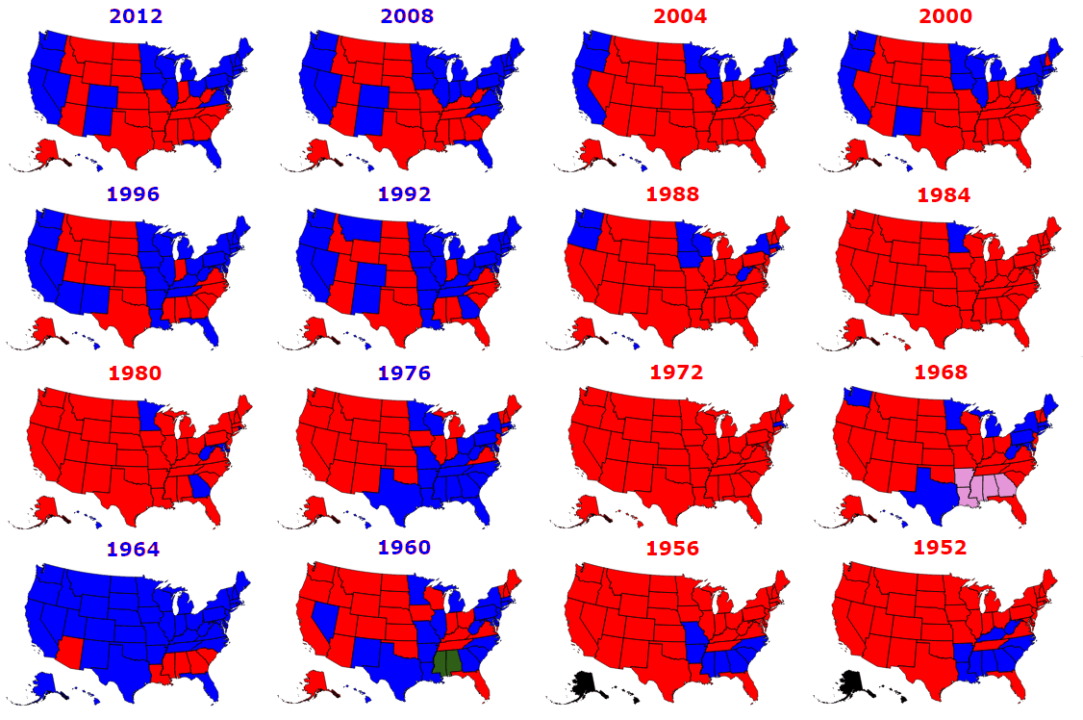
    Beginning in the mid-twentieth century, particularly during the Civil Rights Movement of the 1950s and 1960s, many white Southern conservatives began shifting their political allegiance. As national Democratic leaders increasingly supported civil rights legislation, large numbers of segregationist voters and politicians gradually moved toward the Republican Party.

    This transition did not happen overnight. It unfolded over several decades, from the 1960s through the 1980s and even into the early 1990s. Historians and political scientists commonly refer to this process as political realignment.

    The shift can be seen in electoral patterns across the South. States that had reliably voted for Democratic presidential candidates for nearly a century increasingly began supporting Republican candidates. Conservative Southern politicians who once identified as Democrats also began switching parties.

    Despite this well-documented transformation, some modern political commentators attempt to deny that any realignment occurred. Instead, they argue that the parties remain essentially unchanged and that historical responsibility for segregationist politics belongs exclusively to one party.

    But historical evidence tells a more complicated story.

    The ideological divide in American politics has long revolved less around party labels and more around competing views about civil rights, federal power, and social hierarchy. Over time, the political coalitions representing those views have shifted between parties.

    This is why discussions of American political history require careful attention to ideology, region, and historical context, rather than relying solely on party labels.

    Reducing the history of American civil rights struggles to simple partisan talking points obscures the reality of how political coalitions evolve. Understanding that evolution is essential for understanding the political landscape of the United States today.