Tag: KKK

  • What White Supremacy Actually Means

    What White Supremacy Actually Means

    In political debates today, the term “white supremacy” is often treated as if it only refers to extremist groups of people wearing robes, burning crosses, having shaved heads, sporting swastikas, or openly identifying with organizations like the Ku Klux Klan.
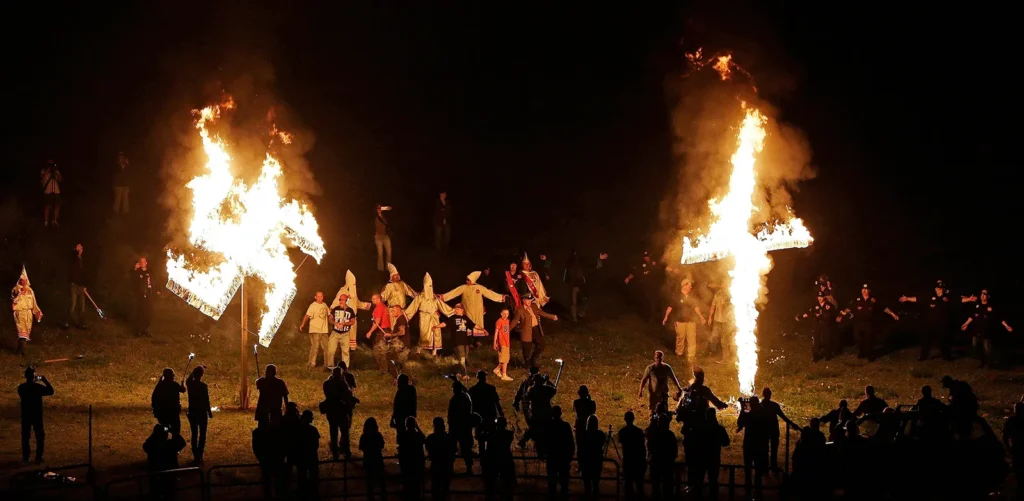
    A cross and a swastika burning at a modern Klan rally.

    But historically and academically, the concept is broader than that.

    White supremacy refers to the belief (explicit or implicit) that white people and white cultural norms represent the highest or most advanced model of civilization and humanity. It is the assumption that whiteness is the standard by which intelligence, morality, competence, and social order should be measured.

    This belief does not always appear in openly violent or in cartoonishly belligerent forms. It often appears in subtler assumptions about who is naturally suited for leadership, who is presumed competent, and who must constantly prove themselves.

    For example, racial explanations are frequently used to explain social outcomes. Certain groups are sometimes associated with crime, others with academic achievement, others with competent leadership, and others with athletic success.

    But when scientists examine many of these assumptions, the explanations often turn out to be social rather than biological.

    A useful example comes from long-distance running.

    For decades, athletes from Kenya and Ethiopia have dominated international distance running competitions, frequently winning Olympic and marathon events. Some Western researchers initially suspected that East Africans might possess unique genetic advantages that gave them superior endurance.

    After extensive study, scientists found no definitive genetic explanation.

    What they did find were social and environmental factors: training culture, altitude conditions, economic incentives, and the perception that success in distance running could provide a path to financial mobility.

    In other words, success was driven less by biology than by opportunity, culture, and motivation.

    The same dynamic appears in many other areas of life. When communities see certain fields as viable paths to advancement and upward socioeconomic mobility, they invest time, energy, and cultural value into those pursuits. This is true whether these pursuits are sports, academics, entertainment, or various professions (think of Irish immigrants of the 19th century and their attraction towards first responder professions).

    When people attribute success or failure primarily to race, they overlook these structural and social factors.

    That is where racial ideology begins to appear.

    If someone believes that race alone determines intelligence, morality, or ability, they are embracing a worldview that closely resembles classical racist thinking. The assumption that certain groups are naturally superior or inferior has historically been used to justify exclusion, discrimination, and unequal opportunity.

    Understanding these ideas requires moving beyond stereotypes and examining how beliefs about race shape expectations and institutions.

    White supremacy, in this broader sense, is not only about extremist organizations.

    It is about the belief that human potential can be ranked according to race, and that some groups are naturally meant to lead while others must struggle to be accepted.

    History and science consistently show that reality is far more complex than that.

  • When I Disagreed With the New Atheists

    When I Disagreed With the New Atheists

    Years ago, I wrote about a debate that took place on Real Time with Bill Maher between Yasiin Bey (formerly Mos Def) on one side and Bill Maher and Christopher Hitchens on the other. The topic, unsurprisingly, was the September 11 attacks and the broader question of Islam.

    At the time, I was widely known among my peers as an atheist thinker and leader. I would jokingly refer to myself as “the atheist.” Because of that, many people expected me to side with Maher and Hitchens. Both men were major figures in the New Atheist movement, and their criticism of religion (especially Islam) was widely embraced within those circles.

    But I found myself agreeing with Yasiin Bey.

    The reason was simple: I have never trusted the United States government’s justifications for many of the wars and military actions it has undertaken since World War II. History provides too many examples of misleading narratives, exaggerated threats, or outright falsehoods used to justify military intervention.

    I was also uncomfortable with the way Muslims were being singled out as uniquely dangerous.

    Most Muslims are not violent extremists. In my own life, I have known many Muslims, and they are as diverse in their beliefs, practices, and interpretations of their religion as Christians or Jews are.

    As a Black American, I also could not ignore another historical reality: my community has experienced far more terrorism from people identifying as Christians than from Muslims. Groups like the Ku Klux Klan cloaked themselves in Christian imagery and language while carrying out campaigns of terror against Black Americans.

    That history makes it difficult for me to accept arguments that treat Islam as uniquely violent while giving Christianity or Judaism a pass for the actions of their worst adherents.

    Maher and Hitchens often insisted that extremist Muslim groups represented something intrinsic to Islam itself. Yet when confronted with violent or extremist groups within Christianity, such as the KKK or Christian Identity movements, they were much quicker to argue that those groups were distortions of the religion rather than expressions of it.

    That double standard always bothered me.

    If organizations like ISIS or Al-Qaeda are considered perversions of Islam (and I believe they are), then the same intellectual honesty should be applied when discussing extremist groups that claim Christian identity.

    At the time, my position drew criticism from some of my fellow atheists. Many people in the New Atheist movement treated Maher and Hitchens almost as intellectual heroes, and disagreeing with them was not always well received.

    But I have always believed that intellectual honesty matters more than tribal loyalty.

    I still respect both Maher and Hitchens for their role in normalizing atheism and encouraging people to question religious authority. Their contributions to secular thought are significant.

    But admiration does not require agreement.

    Even then, I could see that their criticism of religion, particularly Islam, sometimes crossed the line from critique into something that felt more like cultural hostility at best and bigotry at worst.

    Looking back now, I feel even more confident in the position I took at the time.

    Sometimes the most honest place to stand is not with your allies or your critics, but simply where the evidence and your own conscience lead you.