Tag: Obama

  • The Political Tightrope of Black Power

    The Political Tightrope of Black Power

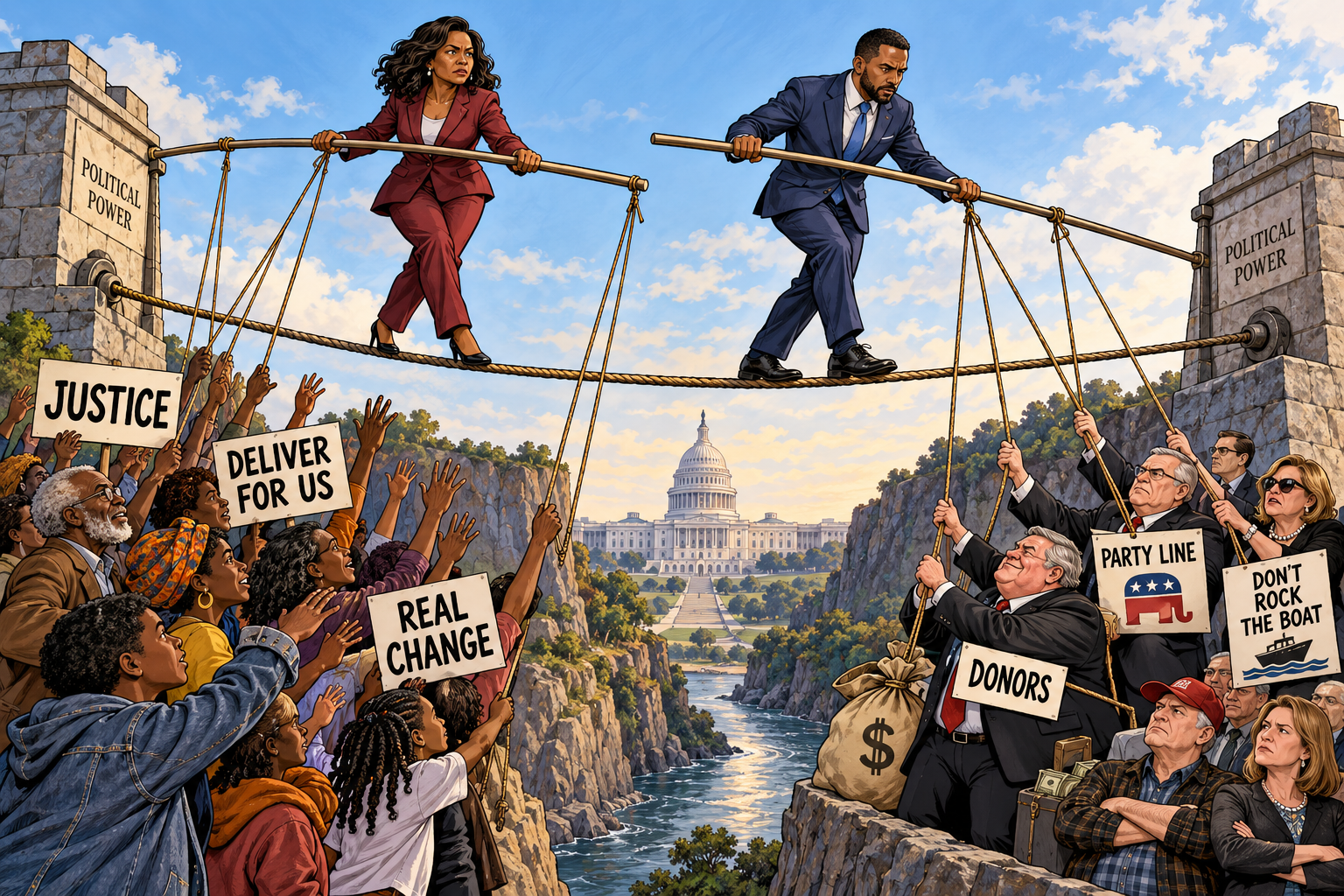
    I think many people (Black, White, and those who identify as neither) fail to understand or appreciate the political tightrope Black people in positions of power have to walk.

    I include myself in that criticism. Some of the things I have criticized Barack Obama for, or watched Kamala Harris get criticized for, deserve another look when we consider the power structure they were operating within.

    Holding office does not mean controlling every lever of power. A “Black face in a high place” does not suddenly erase the influence of wealthy donors, corporate interests, entrenched institutions, or voters who become uncomfortable when Black leadership starts challenging arrangements they benefit from.

    Winning a position within a power structure is not the same as gaining the power to remake it.

    Many Black people and other minorities want leaders like Obama, Harris, Wes Moore, and Jasmine Crockett to speak and act with the radical commitment we associate with Malcolm X, Kathleen Cleaver, Assata Shakur, or Winnie Mandela.

    I understand that desire. I want leaders who will stand up for us too.

    But we have to consider what we are asking of people whose authority depends on operating within institutions that can limit, punish, or remove them. An elected official trying to maintain a governing coalition faces different pressures from an organizer whose purpose is to confront that government.

    That does not make radical leadership impossible. It does make it costly. And we should be honest about who bears those costs and whether we have built enough collective power to support them.

    We cannot demand that someone confront the whole damn structure while assuming their title gives them everything they need to survive the confrontation.

    Some White people also expect Black officials to become the moral voice against every injustice. Apparently, being Black is supposed to make someone courageous, politically flawless, and willing to risk their career whenever the rest of us need a champion.

    But these people are human. They have strengths, weaknesses, ambitions, fears, and limitations like everyone else.

    Their positions also depend, in part, on voters who may praise the idea of justice while rejecting the policies required to achieve it. Some want the reassurance of a Black leader without the discomfort of having that leader challenge them.

    They want representation they can celebrate and leadership they do not have to adjust to.

    That is a hell of a tightrope.

    This does not excuse everything Black politicians say, do, or fail to do. Some choices deserve criticism. Some compromises are unnecessary. Some silences are calculated, and some leaders protect their own careers at the expense of the people who helped put them there.

    We should be able to say that.

    Believe me, I’ve been criticizing many Black politicians for these things, including Obama, Harris, and others on the national stage.

    But we should also distinguish between a failure of commitment and a limitation of power. Before declaring that someone has betrayed us, we ought to ask what they could actually do, what stood in their way, and whether they used the power they did have, not the power we imagined they had.

    Those questions make our criticism stronger.

    They also help explain why the political freedom available to someone like Trump can look so different from the freedom available to someone like Obama.

    In my view, Trump benefits from a level of permission that Black leaders are rarely granted. His belligerence gets celebrated as strength. His disregard for convention gets sold as independence. His supporters can treat conduct they would condemn in a Black politician as proof that he is fighting for them.

    Meanwhile, Black officials are expected to demonstrate restraint, reassure skeptical voters, build consensus, and prove, again and again, that they deserve to be where they are.

    A policy can have public support, and a Black leader can still face hostility for being the person advancing it. The argument may be presented as a disagreement over policy, but race and power can shape whose authority people are willing to accept.

    I have watched that happen too many times to pretend it is incidental.

    There are White voters who will tolerate extraordinary conduct from a White leader while treating a Black leader’s challenge to the status quo as a threat. That tells me their attachment to White power can outweigh the principles they claim to defend.

    And no, that does not describe every White voter. But it describes a political force Black leaders have to account for, whether the rest of us acknowledge it or not.

    My point is that accountability requires us to understand the conditions under which people govern. I am not abandoning my criticism of Obama, Harris, or anyone else. I am asking whether all of that criticism has been fair, informed, and directed at the people who actually held the power to make a different outcome possible.

    We need Black leaders willing to push. We also need organized communities capable of backing them when they do.

    We cannot keep treating a Black person’s election as the transfer of power to Black people as a whole. Until we build the power to make our demands harder to ignore, our representatives will keep walking that tightrope, and we will keep arguing about whether they should have fallen off it for us.
  • MAGA’s Messiah and the Myth of the Good Old Days

    MAGA’s Messiah and the Myth of the Good Old Days

    The thing that fucks me up about the MAGA cult is that so many of them genuinely, blindly, and sadly believe that Chump (Trump) is some messianic figure here to rescue this country from cannibalizing itself through neoliberalism, crony capitalism, and privatization.

    To me, he represents the same appetite dressed up in a red hat. Nepotism, grifting, self-promotion, and incompetence sold as strength. Somehow, his petty belligerence becomes courage. His obsessive whining becomes a legitimate grievance. His need for applause becomes devotion to the country.

    They see a professional con man and call him their savior.

    And what, exactly, is he supposed to save them from? Those imaginary glory days when a White man could supposedly support a family with little education, women happily stayed in the kitchen, and Black people knew their place?

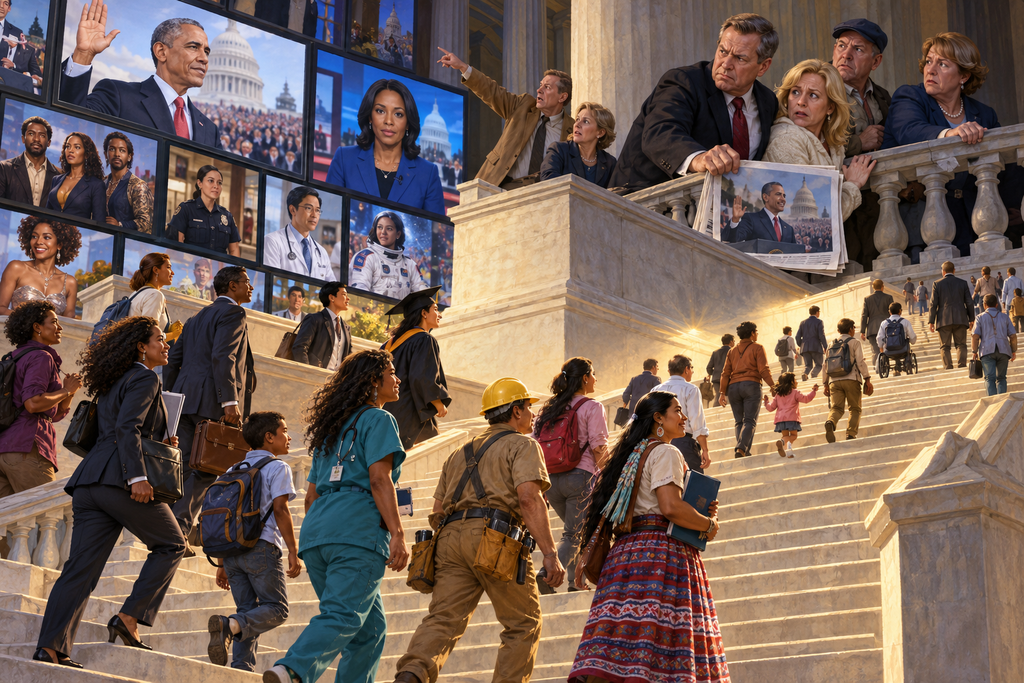
    An AI image of various marginalized groups climb up a tall stairway while there are angry White people on the top. On the left side of the picture, there are screens featuring various racial and ethnic minorities being represented in positions of power and Obama being sworn in as president.
    The visible rise of black people and other marginalized groups into socioeconomic positions once held exclusively by White people, including the presidency, created irrational fear and panic in many White Americans who felt that absolute power, wealth, and prestige belonged only to them.

    Some people had real economic security during those years. But the picture being sold leaves out who was excluded, whose labor was exploited, and whose freedom was sacrificed to maintain it. Women were not universally happy with dependence. Black people were not content with segregation, domestic service, limited menial work opportunities, and second-class citizenship.

    Your nostalgia does not get to erase our history.

    The past they long for is part memory, part mythology, and part desire to restore a hierarchy they think should never have been challenged. They want the wages and purchasing power associated with that period, but too many also want its social arrangements.

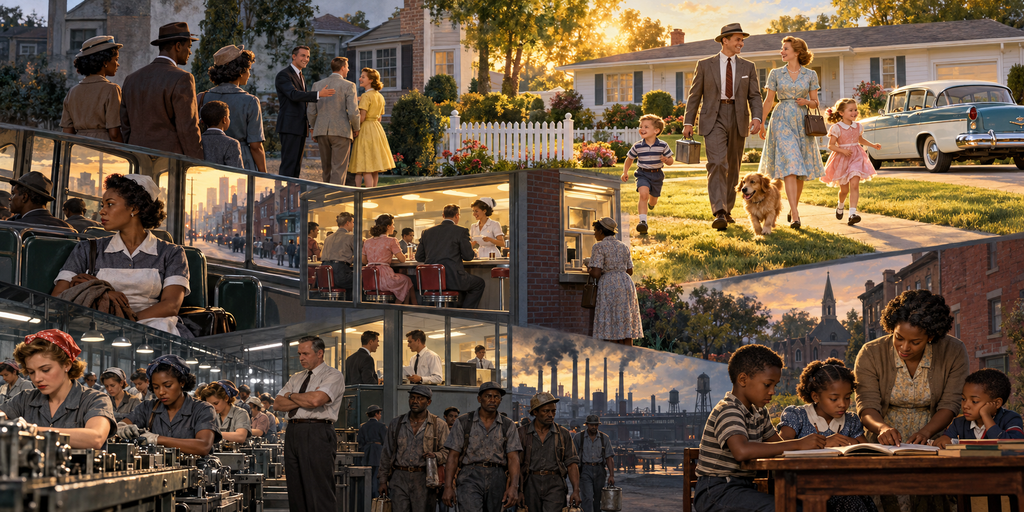
    An AI generated collage of White families moving into the suburbs during the 1950s while Black people and women faced job and housing discrimnation.
    During the United States’ economic golden age, Black people were still mostly working in menial jobs as domestics and laborers. They were being denied equal access to housing, especially in the newly built suburbs.

    Those are two different things. And I wish they would stop pretending otherwise.

    Personally, I never fell under the illusion that Biden (or even Obama) was a hero or a messiah. His presidency is over, and my standard remains the same: policies, actions, competence, and accountability. A diverse cabinet does not automatically transform an administration into a vehicle for liberation. Neither does putting a Democrat in the White House.

    I wanted someone to do his/her fucking job. I also wanted more than competent management of a system that keeps squeezing working people while rewarding those who already own everything.

    That criticism did not disappear because Trump returned to power.

    My problem with MAGA is that its devotion to Chump repeatedly swallows the very accountability its supporters claim to demand. When something goes wrong, somebody else must have caused it. When he contradicts himself, they supply the explanation. When he disappoints them, they move the goalposts.

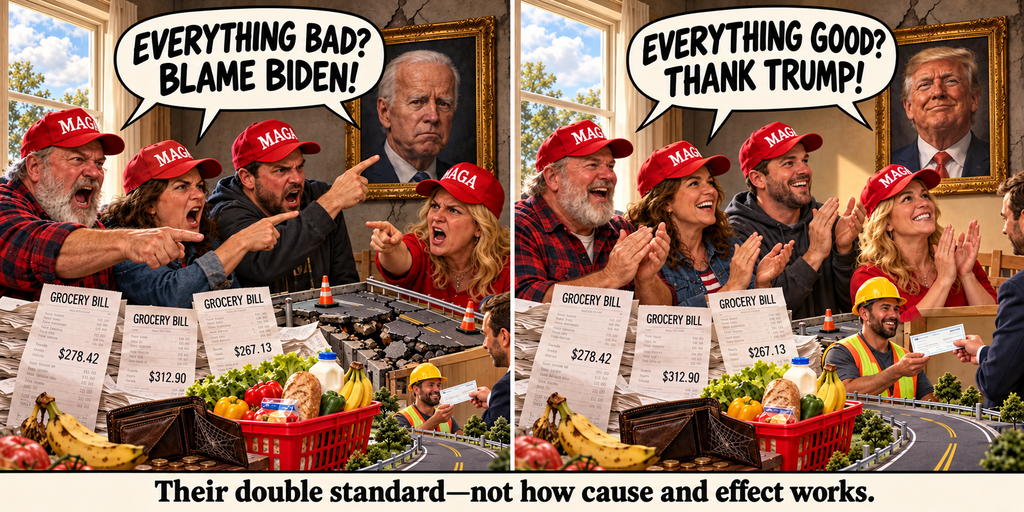
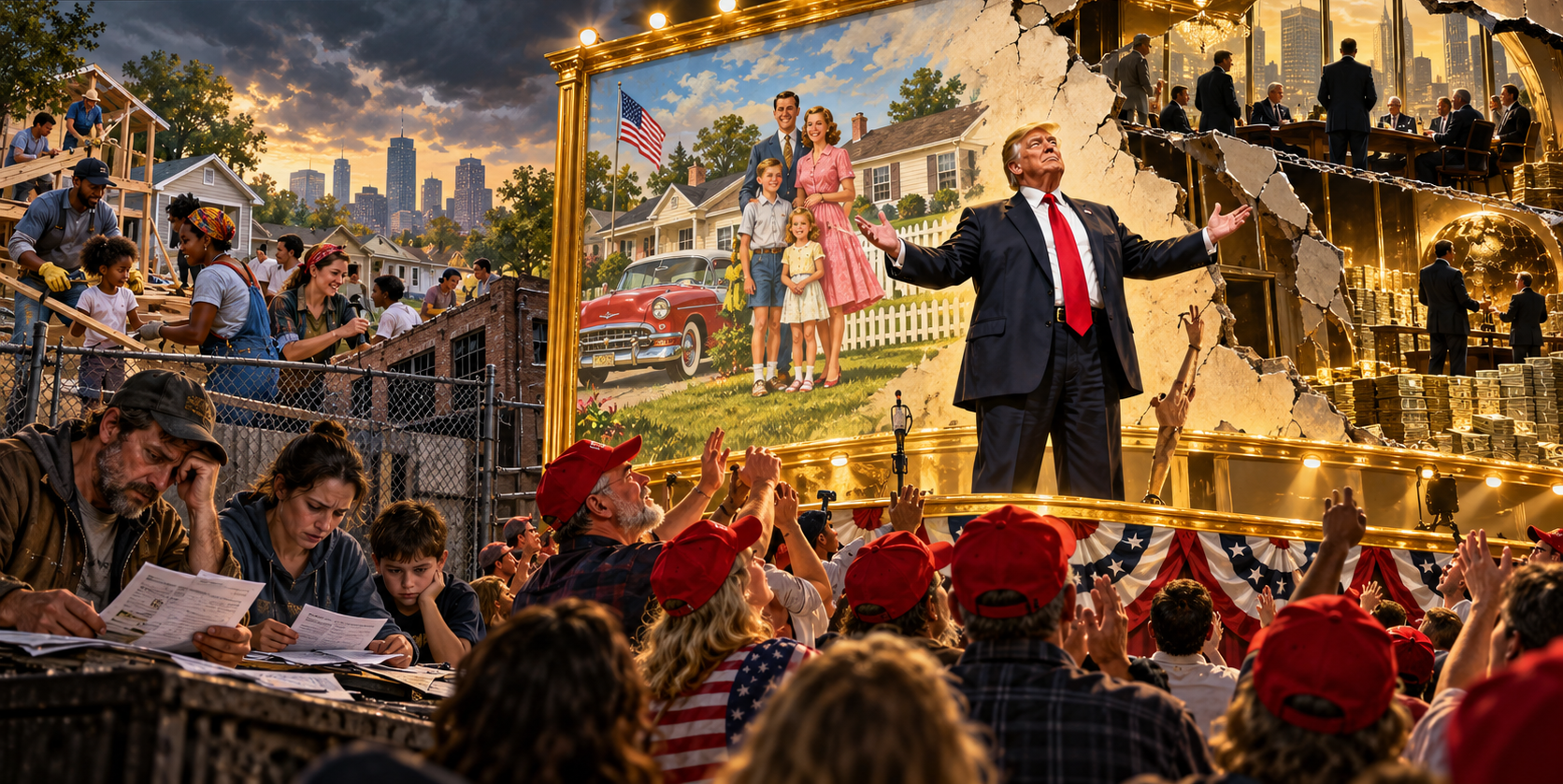
    An AI generated image of Trump being praised for everything good while Biden is blamed for everything bad.
    To many in MAGA, everything bad that happens during Trump’s presidency is the fault of Biden, Obama, or the Democrats. They see everything good as a direct result of Trump’s leadership.

    At what point does the man you elected become responsible for the things he does?

    The economic pain that helped create this movement is not imaginary. Communities have lost jobs, stability, and a sense of a future. But the explanation cannot begin and end with whichever president a cable news host tells you to hate.

    Deindustrialization devastated communities built around factory work. Automation changed how many workers employers needed. Highways and suburban development reshaped cities, often at the expense of established neighborhoods. Energy markets changed. Smaller towns lost employers, young people, and resources.

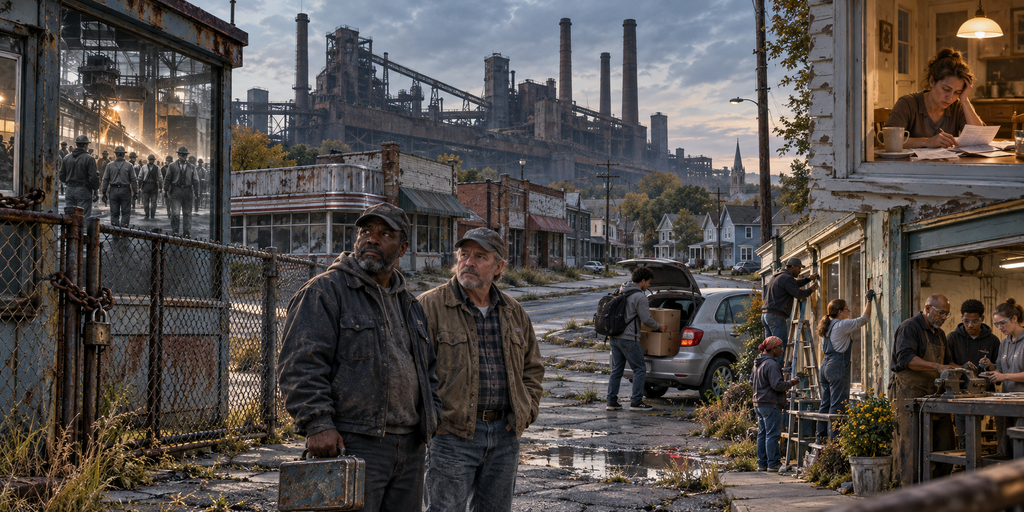
    An AI generated image of the negative effects of deindutrialization to many communities in the United States.
    Deindustrialization devastated once-thriving communities and neighborhoods, leaving them impoverished and blighted.

    These changes did not all come from one president, one party, or one secret meeting of cartoon villains.

    But political choices determined who received protection, who absorbed the losses, and who got rich from the transition. Decisions about labor rights, taxation, trade, public investment, and privatization were very important. And they still are today.

    And administrations from both parties helped build or preserve arrangements that concentrated wealth and weakened working people’s bargaining power.

    That is why I do not accept the idea that electing a billionaire with a talent for branding somehow frees us from billionaire power.

    Chump offers people a villain, a slogan, and somebody to look down on. That does not necessarily give them a pension, affordable housing, healthcare, or control over their working lives.

    You cannot pay the electric bill with the satisfaction of making somebody else miserable.

    I suspect that part of MAGA’s appeal goes beyond economics. For some of its most devoted supporters, the fear is having to share power with women, racial minorities, immigrants, and people of different faiths, gender identities, and sexual orientations.

    Equality feels like dispossession when you believe the country belongs to you.

    They hear demands for equal treatment and imagine revenge. They hear criticism of White supremacy and imagine an attack on their existence. Meanwhile, most of the people they fear are trying to live, raise their children, work, and enjoy some relative peace and prosperity.

    An AI generated photo of Black people living their lives while white people look out their windows fearing revenge.
    Many conservative White people fear acts of revenge from Black people. What they fail to understand is that most Black people just want to have equal opportunities for good neighborhoods, education, and jobs rather than plotting or enacting any form of revenge.

    We should not have to remain subordinate just to make somebody else feel secure.

    And Mango Mussolini’s constant need for praise does nothing to convince me that he is the tough guy he wants people to see. Pettiness is not strength. Vindictiveness is not leadership. Surrounding yourself with loyal sycophants does not make your judgment better.

    Neither does refusing to accept defeat.

    Trump lost the 2020 election and won the 2024 election. Both results can be true. Winning later does not retroactively turn an earlier loss into a stolen victory. If your respect for elections depends on whether your candidate wins, your loyalty is to the candidate.

    That is the problem.

    I have compared this kind of devotion to the danger represented by Jim Jones and the Peoples Temple. That is a serious analogy, and the circumstances are different. But the warning behind it is important here: people become vulnerable when loyalty to a leader takes priority over evidence, judgment, and their own well-being.

    A movement becomes dangerous when every criticism is treated as persecution and every demand from the leader becomes a test of faith.

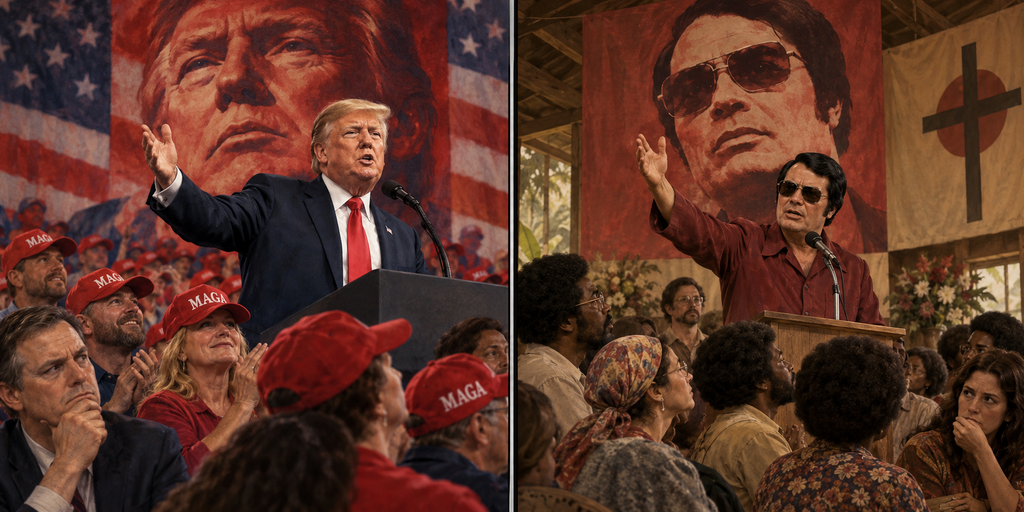
    An AI generated image comparing Donald Trump to Jim Jones.
    MAGA devotion to Trump looks eerily like the devotion that many people had to Jim Jones.

    Cultlike devotion to a person is never a substitute for political principles.

    And yes, that applies to Democrats too. It applies to politicians I like. It applies to politicians you like. Nobody should receive a lifetime exemption from scrutiny because they once inspired us or made the right people angry.

    I do not want a messiah. I want humane policies, accountable leadership, and a society where people can live without being sacrificed to somebody else’s profits.

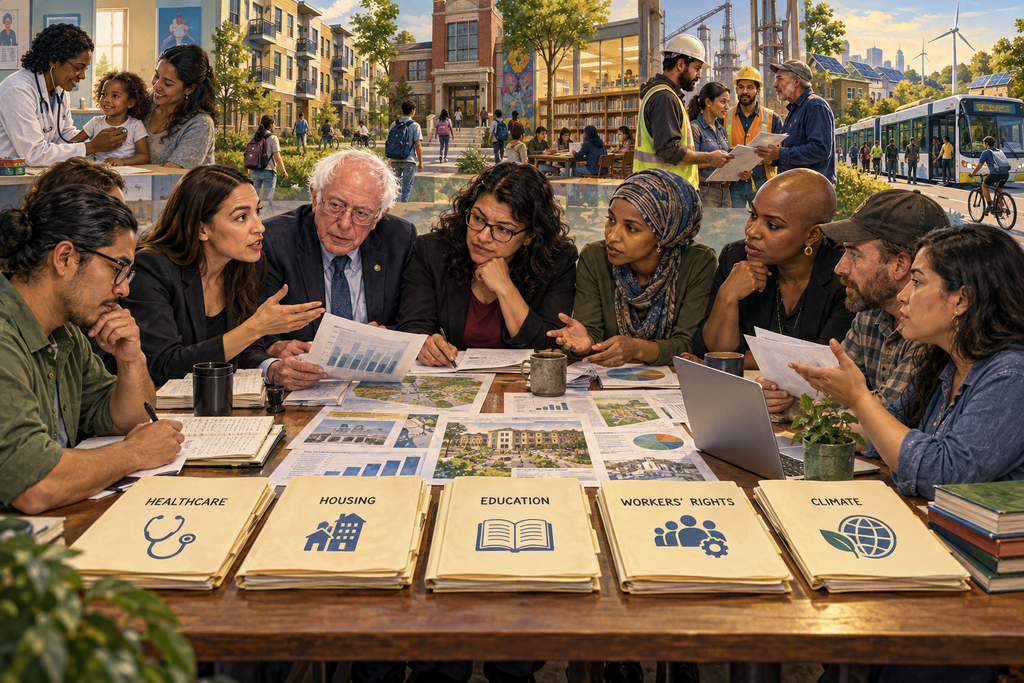
    An AI generated image of Bernie Sanders and the Squad meeting with regular Americans to discuss solutions to problems facing them.
    My admiration for Bernie Sanders and the Squad does not come from a cult of personality. It comes from the policy solutions that they propose and the fact that they seem to address the needs of average Americans rather than corporations and the super-rich. They do this without engaging in culture wars and mindless platitudes.

    The people I call “Y’all-Qaeda” are not going to disappear simply because an election ends or a politician eventually leaves office. The grievances, authoritarian impulses, and appetite for enemies require more than waiting for the next news cycle.

    We have to confront the conditions that make people desperate, and the politics that teach them to aim that desperation at everybody except those benefiting from it.

    Because the country does not need more people worshipping a man who promises to make them great.

    It needs people willing to ask who gets the wealth, who holds the power, and who keeps paying the fucking price.