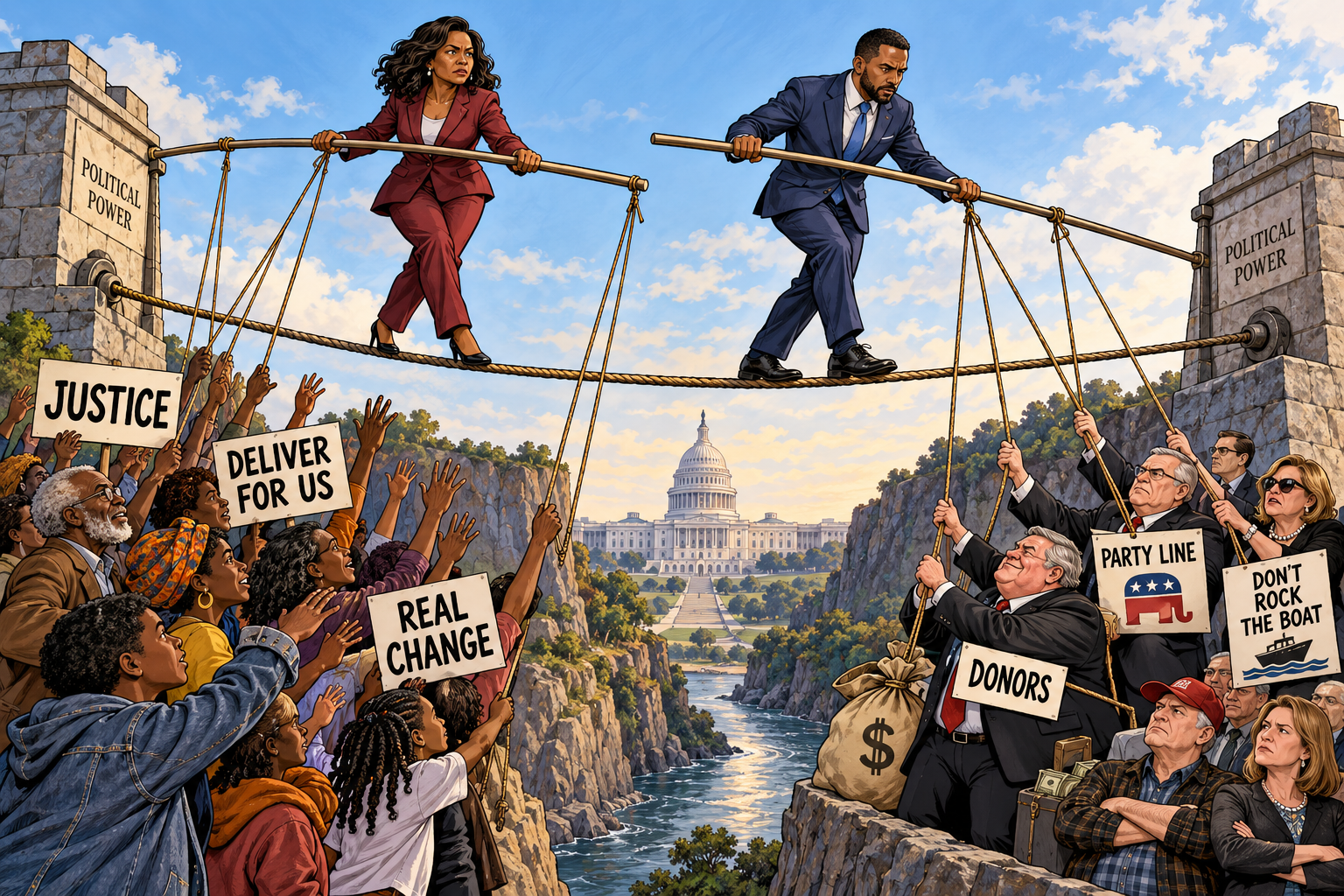
I think many people (Black, White, and those who identify as neither) fail to understand or appreciate the political tightrope Black people in positions of power have to walk.
I include myself in that criticism. Some of the things I have criticized Barack Obama for, or watched Kamala Harris get criticized for, deserve another look when we consider the power structure they were operating within.
Holding office does not mean controlling every lever of power. A “Black face in a high place” does not suddenly erase the influence of wealthy donors, corporate interests, entrenched institutions, or voters who become uncomfortable when Black leadership starts challenging arrangements they benefit from.
Winning a position within a power structure is not the same as gaining the power to remake it.
Many Black people and other minorities want leaders like Obama, Harris, Wes Moore, and Jasmine Crockett to speak and act with the radical commitment we associate with Malcolm X, Kathleen Cleaver, Assata Shakur, or Winnie Mandela.
I understand that desire. I want leaders who will stand up for us too.
But we have to consider what we are asking of people whose authority depends on operating within institutions that can limit, punish, or remove them. An elected official trying to maintain a governing coalition faces different pressures from an organizer whose purpose is to confront that government.
That does not make radical leadership impossible. It does make it costly. And we should be honest about who bears those costs and whether we have built enough collective power to support them.
We cannot demand that someone confront the whole damn structure while assuming their title gives them everything they need to survive the confrontation.
Some White people also expect Black officials to become the moral voice against every injustice. Apparently, being Black is supposed to make someone courageous, politically flawless, and willing to risk their career whenever the rest of us need a champion.
But these people are human. They have strengths, weaknesses, ambitions, fears, and limitations like everyone else.
Their positions also depend, in part, on voters who may praise the idea of justice while rejecting the policies required to achieve it. Some want the reassurance of a Black leader without the discomfort of having that leader challenge them.
They want representation they can celebrate and leadership they do not have to adjust to.
That is a hell of a tightrope.
This does not excuse everything Black politicians say, do, or fail to do. Some choices deserve criticism. Some compromises are unnecessary. Some silences are calculated, and some leaders protect their own careers at the expense of the people who helped put them there.
We should be able to say that.
Believe me, I’ve been criticizing many Black politicians for these things, including Obama, Harris, and others on the national stage.
But we should also distinguish between a failure of commitment and a limitation of power. Before declaring that someone has betrayed us, we ought to ask what they could actually do, what stood in their way, and whether they used the power they did have, not the power we imagined they had.
Those questions make our criticism stronger.
They also help explain why the political freedom available to someone like Trump can look so different from the freedom available to someone like Obama.
In my view, Trump benefits from a level of permission that Black leaders are rarely granted. His belligerence gets celebrated as strength. His disregard for convention gets sold as independence. His supporters can treat conduct they would condemn in a Black politician as proof that he is fighting for them.
Meanwhile, Black officials are expected to demonstrate restraint, reassure skeptical voters, build consensus, and prove, again and again, that they deserve to be where they are.
A policy can have public support, and a Black leader can still face hostility for being the person advancing it. The argument may be presented as a disagreement over policy, but race and power can shape whose authority people are willing to accept.
I have watched that happen too many times to pretend it is incidental.
There are White voters who will tolerate extraordinary conduct from a White leader while treating a Black leader’s challenge to the status quo as a threat. That tells me their attachment to White power can outweigh the principles they claim to defend.
And no, that does not describe every White voter. But it describes a political force Black leaders have to account for, whether the rest of us acknowledge it or not.
My point is that accountability requires us to understand the conditions under which people govern. I am not abandoning my criticism of Obama, Harris, or anyone else. I am asking whether all of that criticism has been fair, informed, and directed at the people who actually held the power to make a different outcome possible.
We need Black leaders willing to push. We also need organized communities capable of backing them when they do.
We cannot keep treating a Black person’s election as the transfer of power to Black people as a whole. Until we build the power to make our demands harder to ignore, our representatives will keep walking that tightrope, and we will keep arguing about whether they should have fallen off it for us.