Tag: political dealignment

  • American History Myths #5: Once More on the Myth That the Major Political Parties Never Realigned

    American History Myths #5: Once More on the Myth That the Major Political Parties Never Realigned

    I’m going to beat the proverbial dead horse here, but I feel I need to reiterate a point I made previously in this blog.

    One of the most persistent myths in modern American political discourse is the claim that the Democratic and Republican parties have remained ideologically consistent throughout history. According to this narrative, the Republican Party has always been the party of civil rights and racial progress, while the Democratic Party has always been the party of racism.

    This claim collapses under even the most basic historical scrutiny.

    To maintain the illusion, modern conservatives must ignore several inconvenient facts. They must ignore the political dealignment and realignment that occurred between the late nineteenth century and the late twentieth century. They must ignore the steady migration of white Southern conservatives—particularly segregationists—from the Democratic Party into the Republican Party during the second half of the twentieth century.

    They must also ignore the uncomfortable reality that many of the political figures celebrated in modern conservative circles were themselves defenders of slavery, segregation, and white supremacy.

    The historical record is clear: the ideology of Southern conservatism did not disappear after the Civil Rights Movement. It simply found a new political home.

    During the 1960s through the 1990s, many of the most hardline segregationist politicians—often referred to as Dixiecrats—gradually abandoned the Democratic Party and aligned themselves with the Republican Party. At the same time, the Republican Party increasingly adopted political strategies designed to attract white Southern voters who opposed civil rights reforms.

    This shift was not subtle. It was openly discussed by political strategists and historians alike.

    Yet modern conservatives often pretend that none of this happened.

    Instead, they promote a simplified narrative in which the Republican Party “freed the slaves” and therefore cannot possibly bear any responsibility for the racial politics that emerged in the twentieth century. The fact that the ideological descendants of segregationists now overwhelmingly identify as conservative Republicans is conveniently ignored.

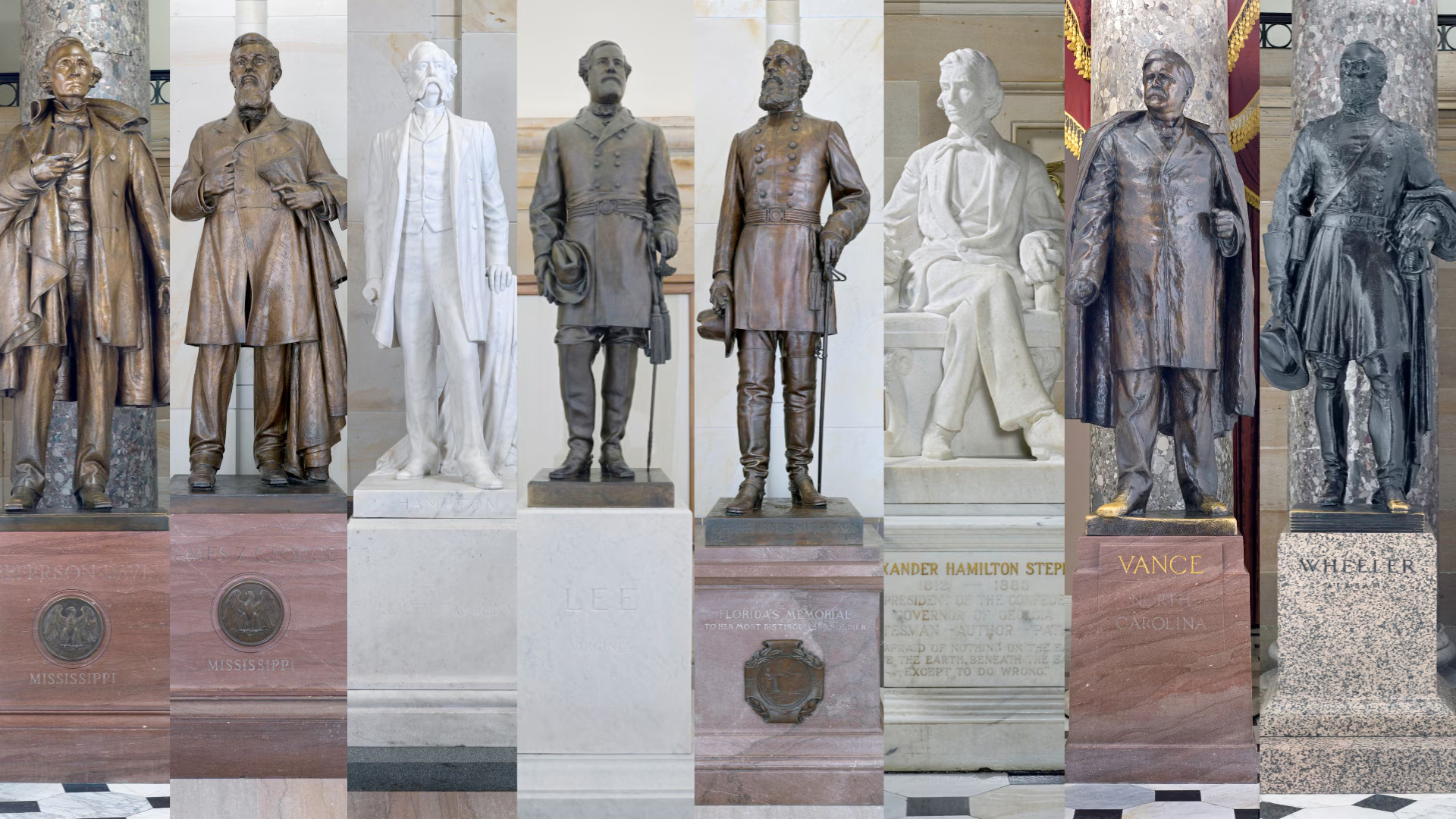
    At the same time, many conservative politicians and commentators openly celebrate figures from the Confederate past while dismissing or ignoring the Republican leaders who actually fought to preserve the Union and end slavery.

    Where are the monuments to Republican generals such as William Tecumseh Sherman or Ulysses S. Grant in the regions that once formed the Confederacy? Why are Confederate leaders, who were Democrats of their time, so often praised in modern conservative political culture?

    The answer is uncomfortable but obvious.

    For many conservatives, the issue has never truly been about party labels. It has always been about political ideology.

    This ideological continuity becomes particularly visible when modern politicians attempt to avoid even the most basic historical truths.

    For example, when asked about the causes of the American Civil War, some contemporary conservative politicians have offered vague explanations about “government,” “freedom,” or “states’ rights,” while carefully avoiding the central issue that historians overwhelmingly agree defined the conflict: chattel slavery.

    Yet the leaders of the Confederacy themselves left no such ambiguity.

    In their own declarations of secession, Southern states repeatedly and explicitly identified the preservation of slavery as the primary reason for leaving the Union.

    The historical record could not be clearer.

    Attempts to obscure that fact are not efforts to promote historical nuance. They are attempts to preserve comforting myths about the past.

    And those myths serve a political purpose.

    By denying the ideological continuity between past and present forms of white supremacist politics, modern conservatives attempt to distance themselves from the legacy of segregation and racial hierarchy while continuing to benefit from many of the political narratives that sustained those systems.

    None of this is to suggest that racism exists exclusively within one political party. Racism has existed across the American political spectrum throughout history.

    But it is impossible to have an honest conversation about American history—or modern American politics—without acknowledging the ideological realignment that reshaped the nation’s two major political parties during the twentieth century.

    History cannot be rewritten simply because it makes some people uncomfortable.

    In fact, the opposite is true.

    Understanding the darker chapters of our past is precisely how societies learn to avoid repeating them.

    Black Americans have long demonstrated that it is possible to love this country while also confronting its historical injustices. Despite centuries of discrimination, violence, and exclusion, Black Americans have served in the nation’s military, represented the country in international competition, and fought relentlessly to expand the promise of American democracy.

    Acknowledging historical injustice does not weaken the country.

    Pretending that those injustices never happened does.

    If Americans truly want to move forward, they must first be willing to tell the truth about where they have been.
  • American History Myth #3: The Myth That Civil Rights Were Simply a “Republican Achievement”

    American History Myth #3: The Myth That Civil Rights Were Simply a “Republican Achievement”

    Modern political debates often reduce complex historical events to simple partisan talking points. One of the most common claims is that the Civil Rights Movement and the landmark civil rights legislation of the 1960s were primarily the achievement of conservative Republicans.

    This claim is frequently used in contemporary political arguments, but it oversimplifies a far more complicated historical reality.

    It relies on several incorrect assumptions:

    1. The Republican Party has always been a party of fiscal, social, and small-government conservatives.
    2. American political parties historically operated as unified ideological blocs rather than coalitions containing both liberal and conservative wings.
    3. Republicans were never involved in segregationist politics, white supremacist movements, or anti-Black rhetoric and policies.

    All three assumptions are historically inaccurate.

    In the decade following the Civil War, Republicans championed early civil rights legislation during Reconstruction. However, after the contested election of 1876 and the Compromise of 1877, which effectively ended Reconstruction, national political commitment to protecting Black civil rights declined dramatically.

    During the late nineteenth and early twentieth centuries, what historians often call the Nadir of American Race Relations (roughly 1887–1923), racist policies and segregation became entrenched across much of the United States. During this period, many politicians from both major parties adopted or tolerated segregationist attitudes.

    Fast forward to the 1960s and the passage of the Civil Rights Act of 1964.

    The legislation was originally proposed by President John F. Kennedy (D) in 1963. After Kennedy’s assassination, President Lyndon B. Johnson (D) made the bill a central priority of his administration and pushed aggressively for its passage.

    Several key members of Congress played major roles in advancing the legislation, including:

    • Hubert Humphrey (D–MN)
    • Emanuel Celler (D–NY)
    • Everett Dirksen (R–IL)
    • William McCulloch (R–OH)

    The final legislation was the result of bipartisan cooperation, though it was strongly driven by the Democratic administration and several Democratic leaders in Congress.

    The final vote totals were:

    House of Representatives
    289–126 (70–30%)

    Senate
    73–27

    When broken down by party, the numbers appear to show stronger Republican support:

    House

    • Democrats: 153–91 (69%)
    • Republicans: 136–35 (82%)

    Senate

    • Democrats: 44–23 (66%)
    • Republicans: 27–6 (82%)

    At first glance, these numbers might suggest that Republicans were the primary supporters of civil rights legislation.

    However, this interpretation ignores a crucial factor: region.

    When the votes are separated by region, a very different pattern appears.

    House of Representatives

    Northern members: 281–32 (90%) in favor
    Southern members: 8–94 (8%) in favor

    Senate

    Northern members: 72–6 (92%) in favor
    Southern members: 1–21 (5%) in favor

    In other words, the major divide was not simply party affiliation—it was North versus South.

    Looking at the votes by both region and party makes this even clearer.

    House

    Southern Democrats: 8–83 (9%) in favor
    Southern Republicans: 0–11 (0%) in favor

    Northern Democrats: 145–8 (95%) in favor
    Northern Republicans: 136–24 (85%) in favor

    Senate

    Southern Democrats: 1–20 (5%) in favor
    Southern Republicans: 0–1 (0%) in favor

    Northern Democrats: 45–1 (98%) in favor
    Northern Republicans: 27–5 (84%) in favor

    Not a single Southern Republican voted for the Civil Rights Act of 1964. Meanwhile, Northern Democrats supported the bill at even higher rates than Northern Republicans.

    Another important point often overlooked in modern political debates is that Democrats held large congressional majorities during this period.

    In the 88th Congress (1964), Democrats held:

    • 66 seats in the Senate
    • 253 seats in the House

    Without substantial Democratic support, the Civil Rights Act simply would not have passed.

    A similar pattern appeared in the Voting Rights Act of 1965. At that time, Democrats held even larger majorities:

    • 68–32 in the Senate
    • 295–140 in the House

    The final votes were:

    House
    333–85

    Senate
    77–19

    Again, both parties supported the legislation. But the historical record shows that the outcome cannot be reduced to a simple narrative about one party single-handedly delivering civil rights.

    The reality is more complex.

    Civil rights legislation in the 1960s passed through bipartisan coalitions, but those coalitions were shaped far more by regional politics and ideological divisions than by party labels alone.

    Reducing this history to a partisan talking point oversimplifies one of the most important political struggles in American history.