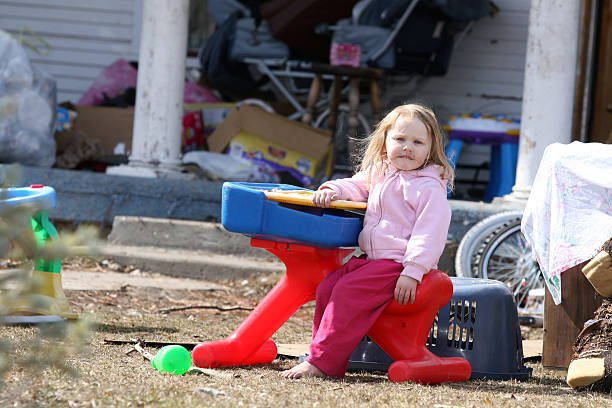
One of the things that traveling around the United States has taught me is that poverty appears remarkably similar, regardless of where you encounter it.
Despite the racial narratives that often dominate political conversations, the visible signs of poverty tend to repeat themselves in the same ways across the country.
The same kinds of conditions that people associate with poor urban neighborhoods (many of which are predominantly Black or Latino) can also be found in economically depressed small towns that are overwhelmingly white.
In both places, you see the same signs of economic struggle.
You see old vehicles with long-expired temporary tags.
You see houses in serious need of repair.
You see groups of men standing around with little to do but pass the time drinking.
You see drug use and the informal economies that grow around poverty, including prostitution.
The physical environments may differ somewhat. Urban poverty often exists in densely populated neighborhoods surrounded by wealthier suburbs. Rural poverty tends to exist in isolated towns surrounded by farmland or land owned by more affluent property holders.
But the underlying conditions are strikingly similar.
Poverty produces the same kinds of social and economic realities regardless of the racial makeup of the people experiencing it.
Traveling makes that clear in a way that political rhetoric often obscures.
In political debates, poverty is frequently racialized. Certain communities are blamed for the conditions in which they live, while others are treated as victims of economic change or government neglect.
But when you actually see these communities up close—when you drive through them, walk through them, and talk to the people who live there—the similarities become difficult to ignore.
Poverty is not confined to one race or one region.
It is a structural condition that appears wherever economic opportunity disappears, and communities are left behind.
And the longer people ignore that reality, the easier it becomes for political narratives to divide communities that are, in many ways, experiencing the same struggles.