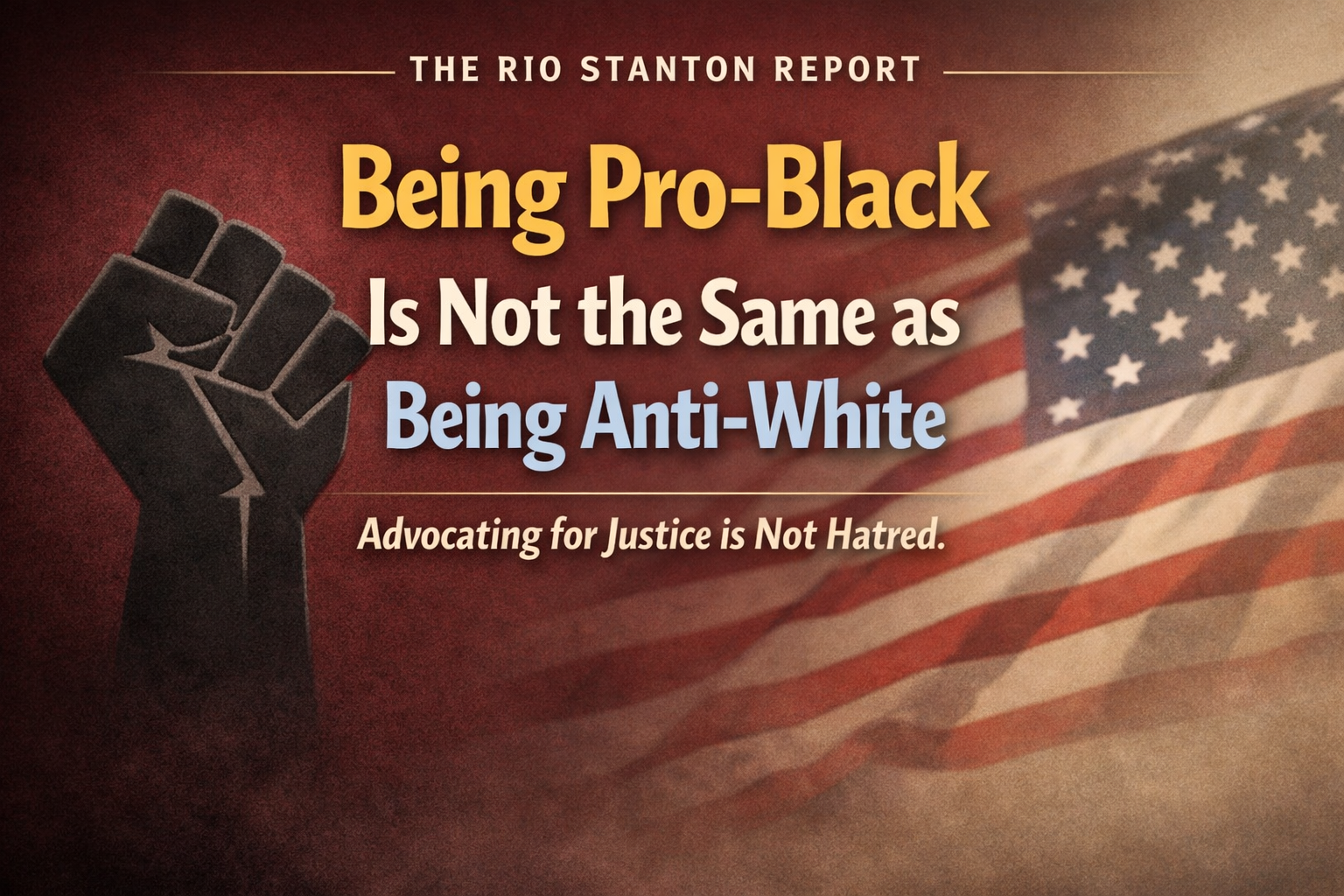
Every so often in public conversations about race, someone will attempt to discredit a person’s arguments by accusing them of hatred or extremism that they never expressed. This tactic usually relies on exaggeration, misrepresentation, or outright fabrication.
Recently, someone repeatedly accused me of calling for genocide against white people. This is an accusation that is not only false but absurd.
Let me be clear about something.
I will never apologize for being pro-Black. I will never apologize for identifying as a Pan-Africanist, and I will never apologize for calling out anti-Black racism wherever I see it. Advocating for the dignity, safety, and advancement of Black people does not require hostility toward anyone else.
But I do care about being truthful about what I believe.
I do not hate white people. What I oppose, firmly and unapologetically, is the ideology and practice of white supremacy. Those two things are not the same.
White supremacy is a political and social system that places one racial group above others. It has shaped laws, institutions, and cultural narratives throughout much of modern history. Criticizing that system is not an attack on individual white people; it is a critique of a structure of power and inequality.
In fact, many of the people who helped shape my life in positive ways have been white.
Throughout my life, white friends, mentors, and supporters have offered encouragement, assistance, and opportunities when I needed them most. Some believed in me when I did not believe in myself. Others provided support during moments when I was struggling personally and emotionally.
Those experiences are part of my life story, and they make it impossible to honestly claim that I hate white people.
At the same time, acknowledging those personal relationships does not mean ignoring the reality of racism. Structural racism and discriminatory narratives continue to shape how people of color, especially Black Americans, are perceived and treated in many areas of society.
Recognizing that reality is not hatred. It is an observation.
Just as individuals and communities should be willing to confront sexism, homophobia, ableism, or other forms of discrimination, societies must also be willing to confront racism honestly. Criticism of injustice is not the same as prejudice against a group of people.
Too often, accusations of “reverse racism” or extreme hostility are used as rhetorical shields to avoid confronting difficult conversations about race and inequality.
But refusing to acknowledge racism does not make it disappear.
Advocating for justice, dignity, and equality for Black people does not require hostility toward other groups. It simply requires honesty about history, power, and the realities that many people still experience.
Being pro-Black is not about hatred. It is about refusing to remain silent in the face of injustice.