Tag: Republicans

  • Stop Trusting Republicans to Play Fair

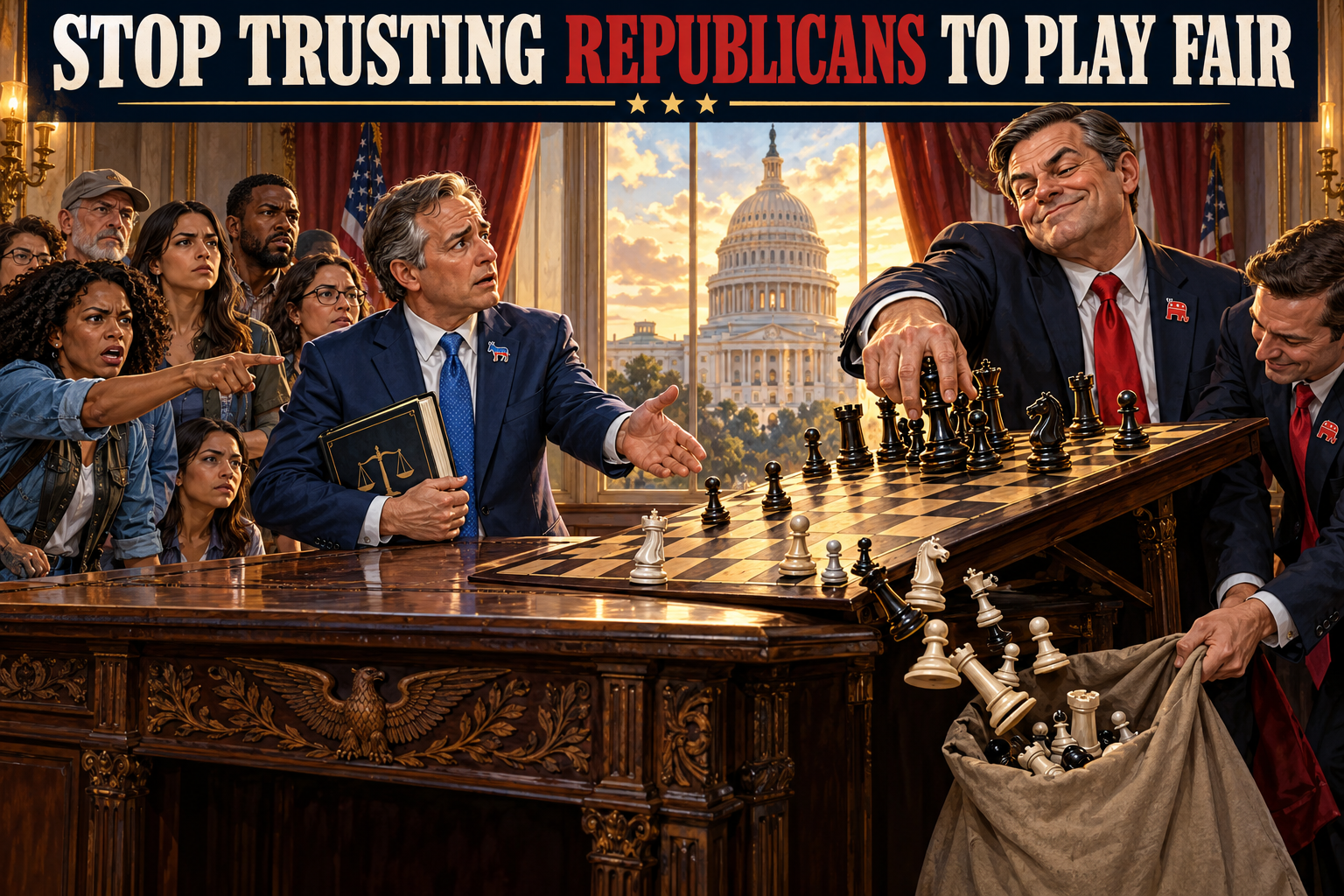
    Stop Trusting Republicans to Play Fair

    One thing that used to really piss me off about the Obama administration (and the Democratic Party as a whole) was the refusal to recognize just how far Republicans were willing to go to gain and keep power.

    Democratic leaders kept looking for reasonable partners. They kept talking about compromise, common ground, and reaching across the aisle. Meanwhile, Republicans kept showing them that their commitment to those things lasted only as long as it served their interests.

    At some point, believing them becomes a choice.

    There is no reasoning your way around people who negotiate in bad faith. There is no meaningful compromise when one side treats every concession as an opportunity to demand more. The Democratic Party needs to stand up and fight tooth and nail for the principles it claims to hold.

    But the lessons of the Obama years still don’t seem to have sunk in.

    We keep waiting for Republicans to come to their senses, embrace their better angels, or stand by their own words. Then, when they abandon those words, Democratic leaders act disappointed. They seem to think disappointment is going to shame Republicans into changing their behavior.

    How many times do we have to watch this?

    The fight over the Supreme Court in 2020 made this painfully clear. Some people genuinely counted on a handful of Republican senators to honor the standard their party had used to block Obama’s Supreme Court nominee. They expected consistency from people who had already demonstrated that the rules could change whenever power was at stake.

    After the Senate failed to convict Trump in his first impeachment trial, some still believed that those same Republican senators would suddenly put fairness ahead of political advantage.

    Why? What had they done to earn that faith?

    The Democratic leadership, the corporate media, and far too many liberals keep convincing themselves that this time Republicans will play fairly. This time, institutional norms will hold. This time, someone will discover a conscience.

    And when that doesn’t happen, we get another round of solemn speeches about how troubling it all is.

    I am tired of being told to admire the restraint of people who keep getting their asses handed to them.

    There is a familiar saying about doing the same thing over and over again and expecting different results. Whoever first said it, the point applies here. It is beyond frustrating to watch Democratic leaders repeat an approach that keeps failing, then have their defenders insist that the rest of us simply don’t understand the strategy.

    Apparently, they’re always playing three-dimensional chess. Apparently, every defeat is part of some brilliant plan that will reveal itself later.

    Meanwhile, the whole thing looks more like Wile E. Coyote chasing the damn Road Runner.

    And every time a liberal shows up to explain that my lack of faith is unwarranted, I want to ask: What, exactly, am I supposed to be impressed by?

    The speeches? The stern letters? The commitment to looking reasonable while the other side takes what it wants?

    I do not need another lecture about patience from someone who confuses having a strategy with defending whatever the leadership happens to do.

    Compromise requires people who will honor an agreement. When political leaders repeatedly abandon their own standards for an advantage, trusting them again should require evidence—not another appeal to their supposed decency.

    And compromise itself should not be treated as a virtue regardless of what gets surrendered. People’s rights, livelihoods, and futures are on the line. The goal cannot simply be to reach an agreement so everyone in Washington can congratulate themselves for being bipartisan.

    The goal should be to deliver something worth fighting for.

    Democratic leaders need to stop acting as though Republican approval is necessary to make their demands legitimate. Make the case. Use the power voters gave you. Organize. Give people a reason to show up, stay involved, and believe that their participation matters.

    If the party claims to stand for working people, civil rights, and democracy, then it needs to fight like those commitments mean something.

    Stop trusting Republicans to become the partners you wish they were. Make your demands, prepare for a real political fight, and rally the damn people behind you.
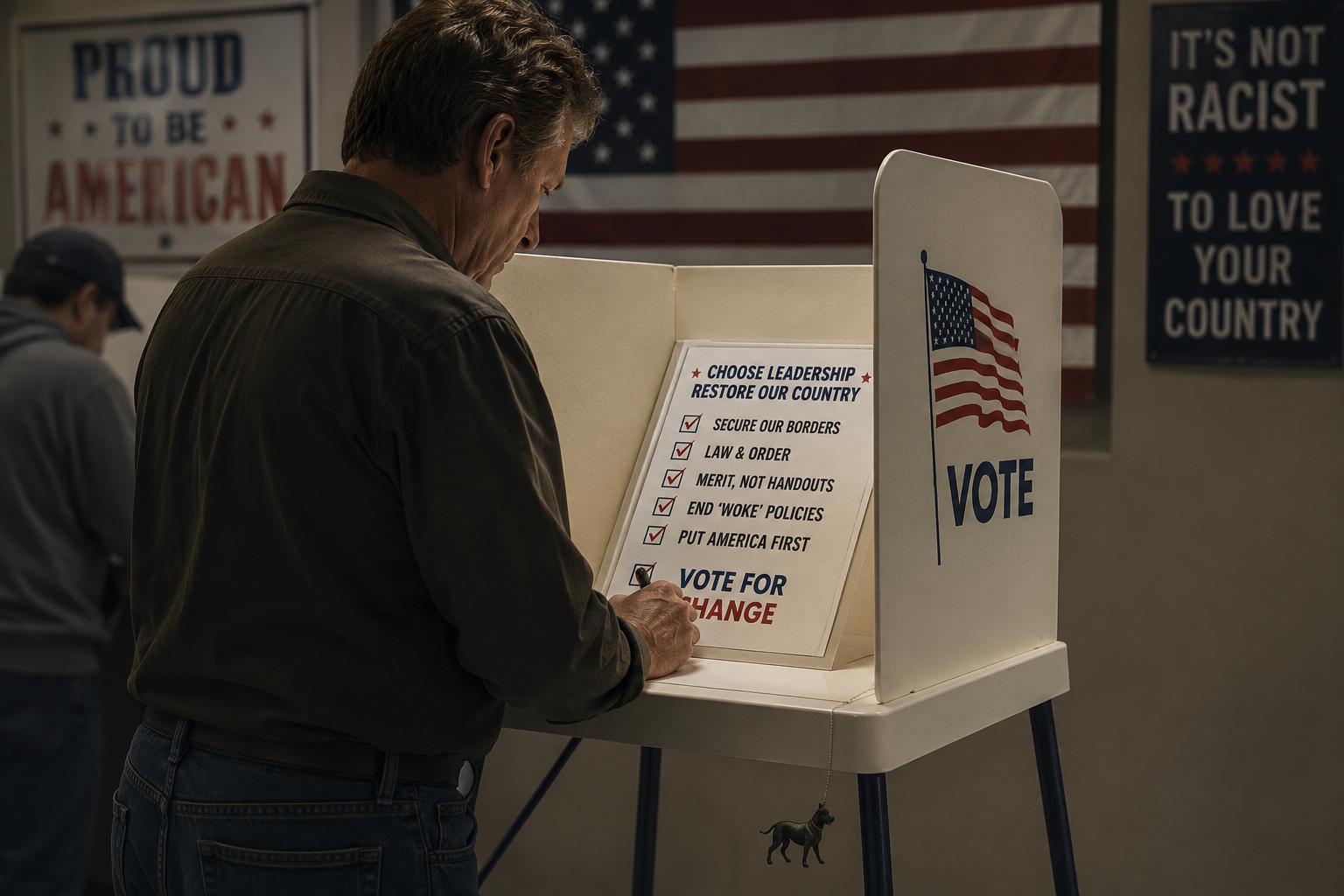
  • America’s Racial Problem Is Not in the Past, And I’m Tired of People Pretending It Is

    America’s Racial Problem Is Not in the Past, And I’m Tired of People Pretending It Is

    One of the most frustrating parts of talking about racism in America is how often people act as if it is either exaggerated, isolated, or long behind us. Every time I say that most white Americans have, at minimum, participated in or benefited from racist systems and behavior, there is always a predictable backlash. The conversation shifts from the reality of racism to defensive utterances, including people charging me with racism, exaggerated claims of Black culpability in slavery, sloppy attempts to “both-sides” racism, and arguing that racism was a past reality that black people need to get over.

    But history (and the present) tell a very different story, and I’m not pulling that conclusion out of thin air.

    I’m looking at history, voting patterns, where people choose to live, how they react when Black people move into their neighborhoods, what they tolerate politically, and what I have personally watched happen over and over again in this country.

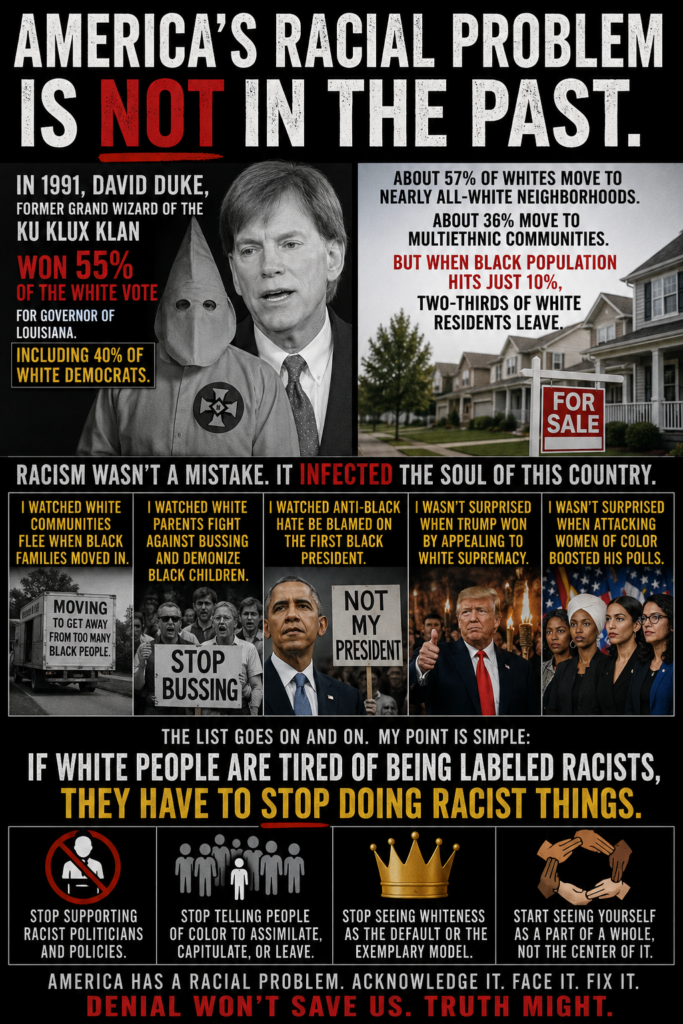
    In 1991, David Duke, a former Grand Wizard of the Ku Klux Klan, won 55% of the white vote when he ran for governor of Louisiana. Let that sink in. A man whose public identity was openly tied to white supremacy won a majority of white voters, including 40% of white Democrats. That was not the distant 1800s. That was the early 1990s.

    And this pattern is not an isolated one. Since the passage of the Civil Rights Act of 1964 and the Voting Rights Act of 1965, Democratic presidential candidates have consistently struggled to win the white vote. Even in 1976, when Jimmy Carter performed unusually well among white voters, Gerald Ford still won them overall. That should force us to ask uncomfortable questions about what racial backlash has looked like in American politics for the last half-century.

    These are not random or meaningless occurances. And it is not just “economic anxiety.” This is racism built into the bloodstream of American politics and manifest through voting decisions and patterns.

    The same dynamic has shaped where people live, where they send their children to school, and how they define “good” neighborhoods and “bad” neighborhoods. White flight did not happen by accident. It was not simply about “better schools” or “quality of life.”

    For decades, study after study (and plain old lived reality) has shown that white people love to talk about diversity until Black people actually start moving in next door. White families will say they want “good communities” and “nice neighborhoods,” but once a place becomes “too Black” (usually with a Black population at or above 10%), all of a sudden the moving trucks come out and the “For Sale” signs start multiplying like weeds.

    In community after community, once Black families moved in, white families moved out. I have seen it with my own eyes. Entire white communities expanded further and further outward, into what had once been farmland, not because they were escaping crime or collapse, but because too many Black people had moved nearby.

    And it did not matter if those Black families were educated, professional, stable, or middle class. Their Blackness alone was enough for those white families to flee further into the suburbs.

    We want to act like racism was just Bull Connor, George Wallace, fire hoses, and white robes. We want to tell ourselves that racism was a regrettable chapter that “we overcame,” and now the only real racists are a few cartoonishly evil people at the margins.

    That is a lie.

    Racism in America was never just about the loudest extremists. It has always depended on ordinary white people making racist choices in ordinary ways: where they live, who they vote for, what schools they support, what fears they indulge, what policies they excuse, and what kind of treatment of Black people they are willing to rationalize.

    I saw white parents rage against school bussing while talking about Black children as if they were grave threats. I saw anti-Black hostility dressed up as “concern” and “standards.” I saw white resentment toward Barack Obama, a man raised largely by white family members, treated as if he were some dangerous racial radical simply for existing in the White House while Black.

    So no, I was not surprised when Donald Trump rose to power by openly winking at white grievance and white nationalism. I was not surprised when racist attacks on women of color energized parts of his base. I have seen this movie before.

    A lot of white Americans want to be absolved without being examined.

    They want credit for not wearing a hood while still supporting racist politicians, racist policies, racist housing patterns, racist school systems, and racist cultural assumptions.

    That’s not how this works.

    America’s racial problem has never been confined to a handful of extremists in white robes. That is the lie people tell themselves so they do not have to examine the everyday racism embedded in housing, education, politics, media, and social life. Racism in America has never just been about “bad people.” It has been about a society that trained millions of ordinary people to see whiteness as the norm, the standard, and the default.

    And that is the real issue.

    If white Americans are tired of being associated with racism, then the answer is not to get offended when people point it out. The answer is to stop supporting racist policies, racist politicians, racist assumptions, and racist social arrangements. Stop demanding that people of color quietly assimilate into a system built to marginalize them. Stop treating whiteness as the universal model of what is “normal,” “civilized,” or “American.”

    Because America’s racial problem is not ancient history. It is not dead. And pretending otherwise is part of the problem.

  • Political Demonization and the Collapse of Civil Discourse

    Political Demonization and the Collapse of Civil Discourse

    Over the past several decades, a pattern has emerged in American political rhetoric, particularly in certain corners of conservative media and political leadership.

    People on the political left are not merely described as political opponents. We are often portrayed as existential threats to the nation.

    For years, many prominent conservative commentators and politicians have repeatedly described Democrats and left-leaning Americans as:

    • Anti-American or people who “hate America”
    • Socialists or communists
    • Participants in child-trafficking conspiracies
    • Doctors who secretly perform gender surgeries on children without parental knowledge
    • Supporters of violent crime
    • Architects of mass immigration designed to manipulate elections
    • Violent extremists who are responsible for “burning down cities”
    • Lazy individuals who simply want government handouts
    • Rampant sexual deviants who want to groom children into non-heteronormative lifestyles

    Many of these accusations are not policy disagreements. They are moral accusations. They are claims that state that their political opponents are fundamentally dangerous, corrupt, or evil.

    When these claims are repeated constantly through media ecosystems, they can shape how entire audiences perceive political reality. Over time, exaggerated or false narratives can become accepted as unquestioned truths.

    This dynamic has serious consequences.

    When political opponents are portrayed not simply as people with different policy views but as criminals, traitors, or threats to society, it becomes easier for some individuals to justify hostility or even lethal violence against them.

    At the same time, many of the same political figures who use this kind of rhetoric often react strongly when criticism is directed toward them. Labels such as “bigot” (in any form), “authoritarian,” or “fascist” are often condemned as unfair or offensive, even when critics argue that those labels are based on observable political behavior.

    The result is a deeply polarized environment in which one side hurls childish insults, irrational accusations, and charges of civic disloyalty, which endangers those on the receiving end. Then they clutch their pearls when met with the same energy in response.

    In the end, our political conversation devolves into arguing against strawman caricatures of people, on either side, rather than having good-faith arguments based on facts and reality.

    Healthy democratic societies require disagreement. Political conflict is inevitable and often productive.

    But democracy becomes fragile when political actors stop treating their opponents as fellow citizens and begin treating them as soulless enemies who don’t love the land that we are in.

    Once that shift happens, civil discourse becomes nearly impossible, and political conflict begins to resemble cultural warfare rather than democratic debate.

  • American History Myths #5: Once More on the Myth That the Major Political Parties Never Realigned

    American History Myths #5: Once More on the Myth That the Major Political Parties Never Realigned

    I’m going to beat the proverbial dead horse here, but I feel I need to reiterate a point I made previously in this blog.

    One of the most persistent myths in modern American political discourse is the claim that the Democratic and Republican parties have remained ideologically consistent throughout history. According to this narrative, the Republican Party has always been the party of civil rights and racial progress, while the Democratic Party has always been the party of racism.

    This claim collapses under even the most basic historical scrutiny.

    To maintain the illusion, modern conservatives must ignore several inconvenient facts. They must ignore the political dealignment and realignment that occurred between the late nineteenth century and the late twentieth century. They must ignore the steady migration of white Southern conservatives—particularly segregationists—from the Democratic Party into the Republican Party during the second half of the twentieth century.

    They must also ignore the uncomfortable reality that many of the political figures celebrated in modern conservative circles were themselves defenders of slavery, segregation, and white supremacy.

    The historical record is clear: the ideology of Southern conservatism did not disappear after the Civil Rights Movement. It simply found a new political home.

    During the 1960s through the 1990s, many of the most hardline segregationist politicians—often referred to as Dixiecrats—gradually abandoned the Democratic Party and aligned themselves with the Republican Party. At the same time, the Republican Party increasingly adopted political strategies designed to attract white Southern voters who opposed civil rights reforms.

    This shift was not subtle. It was openly discussed by political strategists and historians alike.

    Yet modern conservatives often pretend that none of this happened.

    Instead, they promote a simplified narrative in which the Republican Party “freed the slaves” and therefore cannot possibly bear any responsibility for the racial politics that emerged in the twentieth century. The fact that the ideological descendants of segregationists now overwhelmingly identify as conservative Republicans is conveniently ignored.

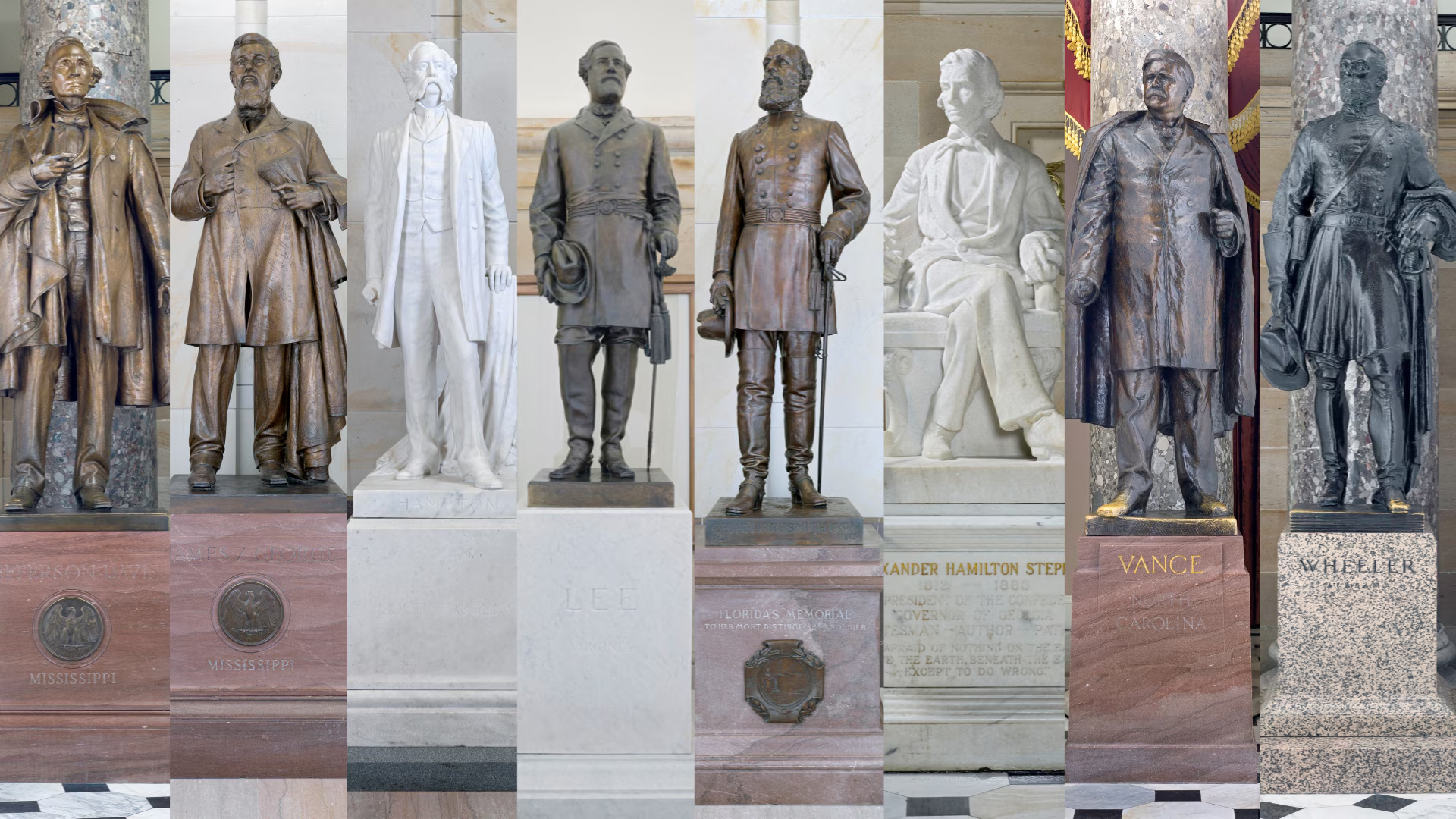
    At the same time, many conservative politicians and commentators openly celebrate figures from the Confederate past while dismissing or ignoring the Republican leaders who actually fought to preserve the Union and end slavery.

    Where are the monuments to Republican generals such as William Tecumseh Sherman or Ulysses S. Grant in the regions that once formed the Confederacy? Why are Confederate leaders, who were Democrats of their time, so often praised in modern conservative political culture?

    The answer is uncomfortable but obvious.

    For many conservatives, the issue has never truly been about party labels. It has always been about political ideology.

    This ideological continuity becomes particularly visible when modern politicians attempt to avoid even the most basic historical truths.

    For example, when asked about the causes of the American Civil War, some contemporary conservative politicians have offered vague explanations about “government,” “freedom,” or “states’ rights,” while carefully avoiding the central issue that historians overwhelmingly agree defined the conflict: chattel slavery.

    Yet the leaders of the Confederacy themselves left no such ambiguity.

    In their own declarations of secession, Southern states repeatedly and explicitly identified the preservation of slavery as the primary reason for leaving the Union.

    The historical record could not be clearer.

    Attempts to obscure that fact are not efforts to promote historical nuance. They are attempts to preserve comforting myths about the past.

    And those myths serve a political purpose.

    By denying the ideological continuity between past and present forms of white supremacist politics, modern conservatives attempt to distance themselves from the legacy of segregation and racial hierarchy while continuing to benefit from many of the political narratives that sustained those systems.

    None of this is to suggest that racism exists exclusively within one political party. Racism has existed across the American political spectrum throughout history.

    But it is impossible to have an honest conversation about American history—or modern American politics—without acknowledging the ideological realignment that reshaped the nation’s two major political parties during the twentieth century.

    History cannot be rewritten simply because it makes some people uncomfortable.

    In fact, the opposite is true.

    Understanding the darker chapters of our past is precisely how societies learn to avoid repeating them.

    Black Americans have long demonstrated that it is possible to love this country while also confronting its historical injustices. Despite centuries of discrimination, violence, and exclusion, Black Americans have served in the nation’s military, represented the country in international competition, and fought relentlessly to expand the promise of American democracy.

    Acknowledging historical injustice does not weaken the country.

    Pretending that those injustices never happened does.

    If Americans truly want to move forward, they must first be willing to tell the truth about where they have been.

  • American History Myth #3: The Myth That Civil Rights Were Simply a “Republican Achievement”

    American History Myth #3: The Myth That Civil Rights Were Simply a “Republican Achievement”

    Modern political debates often reduce complex historical events to simple partisan talking points. One of the most common claims is that the Civil Rights Movement and the landmark civil rights legislation of the 1960s were primarily the achievement of conservative Republicans.

    This claim is frequently used in contemporary political arguments, but it oversimplifies a far more complicated historical reality.

    It relies on several incorrect assumptions:

    1. The Republican Party has always been a party of fiscal, social, and small-government conservatives.
    2. American political parties historically operated as unified ideological blocs rather than coalitions containing both liberal and conservative wings.
    3. Republicans were never involved in segregationist politics, white supremacist movements, or anti-Black rhetoric and policies.

    All three assumptions are historically inaccurate.

    In the decade following the Civil War, Republicans championed early civil rights legislation during Reconstruction. However, after the contested election of 1876 and the Compromise of 1877, which effectively ended Reconstruction, national political commitment to protecting Black civil rights declined dramatically.

    During the late nineteenth and early twentieth centuries, what historians often call the Nadir of American Race Relations (roughly 1887–1923), racist policies and segregation became entrenched across much of the United States. During this period, many politicians from both major parties adopted or tolerated segregationist attitudes.

    Fast forward to the 1960s and the passage of the Civil Rights Act of 1964.

    The legislation was originally proposed by President John F. Kennedy (D) in 1963. After Kennedy’s assassination, President Lyndon B. Johnson (D) made the bill a central priority of his administration and pushed aggressively for its passage.

    Several key members of Congress played major roles in advancing the legislation, including:

    • Hubert Humphrey (D–MN)
    • Emanuel Celler (D–NY)
    • Everett Dirksen (R–IL)
    • William McCulloch (R–OH)

    The final legislation was the result of bipartisan cooperation, though it was strongly driven by the Democratic administration and several Democratic leaders in Congress.

    The final vote totals were:

    House of Representatives
    289–126 (70–30%)

    Senate
    73–27

    When broken down by party, the numbers appear to show stronger Republican support:

    House

    • Democrats: 153–91 (69%)
    • Republicans: 136–35 (82%)

    Senate

    • Democrats: 44–23 (66%)
    • Republicans: 27–6 (82%)

    At first glance, these numbers might suggest that Republicans were the primary supporters of civil rights legislation.

    However, this interpretation ignores a crucial factor: region.

    When the votes are separated by region, a very different pattern appears.

    House of Representatives

    Northern members: 281–32 (90%) in favor
    Southern members: 8–94 (8%) in favor

    Senate

    Northern members: 72–6 (92%) in favor
    Southern members: 1–21 (5%) in favor

    In other words, the major divide was not simply party affiliation—it was North versus South.

    Looking at the votes by both region and party makes this even clearer.

    House

    Southern Democrats: 8–83 (9%) in favor
    Southern Republicans: 0–11 (0%) in favor

    Northern Democrats: 145–8 (95%) in favor
    Northern Republicans: 136–24 (85%) in favor

    Senate

    Southern Democrats: 1–20 (5%) in favor
    Southern Republicans: 0–1 (0%) in favor

    Northern Democrats: 45–1 (98%) in favor
    Northern Republicans: 27–5 (84%) in favor

    Not a single Southern Republican voted for the Civil Rights Act of 1964. Meanwhile, Northern Democrats supported the bill at even higher rates than Northern Republicans.

    Another important point often overlooked in modern political debates is that Democrats held large congressional majorities during this period.

    In the 88th Congress (1964), Democrats held:

    • 66 seats in the Senate
    • 253 seats in the House

    Without substantial Democratic support, the Civil Rights Act simply would not have passed.

    A similar pattern appeared in the Voting Rights Act of 1965. At that time, Democrats held even larger majorities:

    • 68–32 in the Senate
    • 295–140 in the House

    The final votes were:

    House
    333–85

    Senate
    77–19

    Again, both parties supported the legislation. But the historical record shows that the outcome cannot be reduced to a simple narrative about one party single-handedly delivering civil rights.

    The reality is more complex.

    Civil rights legislation in the 1960s passed through bipartisan coalitions, but those coalitions were shaped far more by regional politics and ideological divisions than by party labels alone.

    Reducing this history to a partisan talking point oversimplifies one of the most important political struggles in American history.