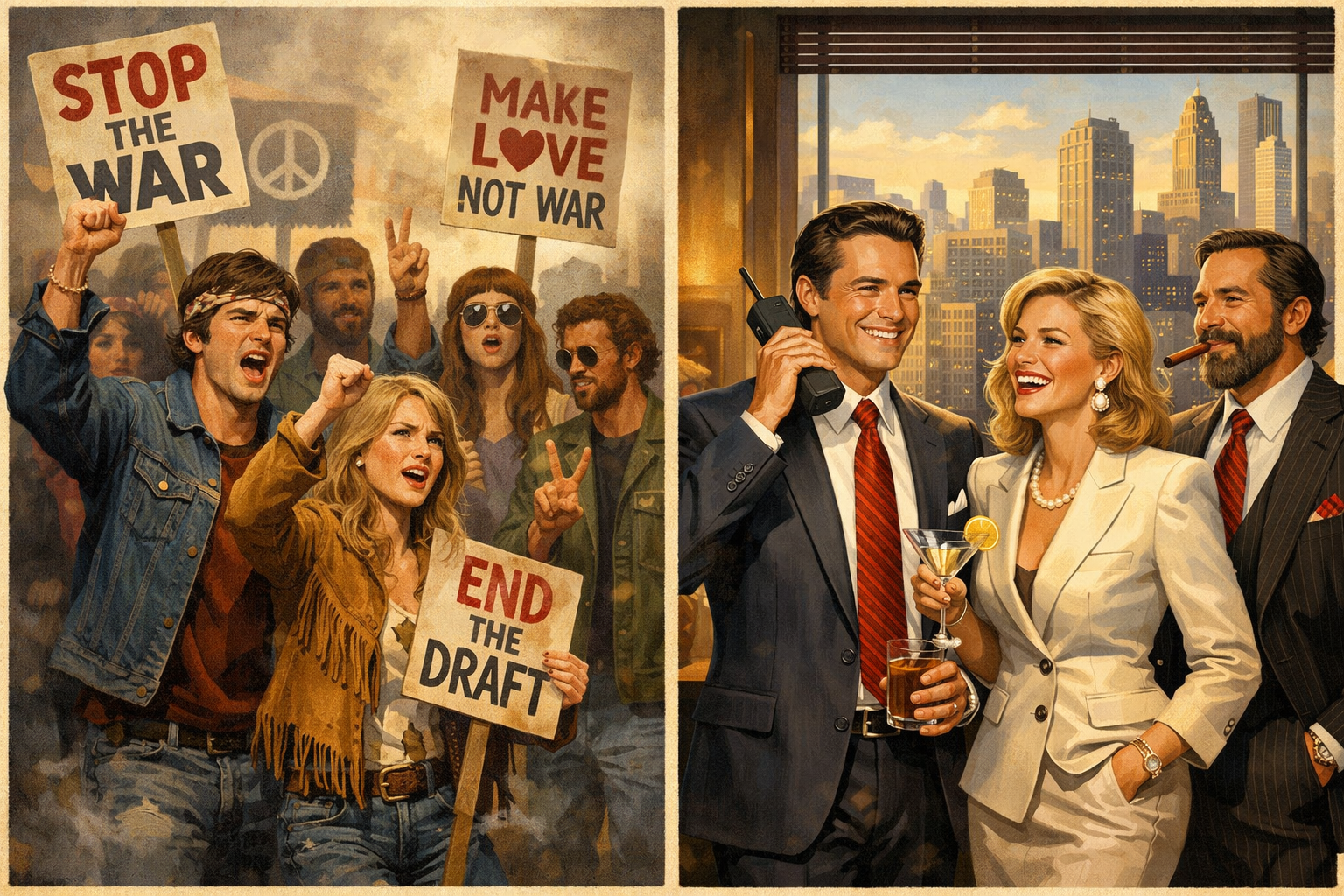
One of the things that has always puzzled me about the Baby Boomer generation is the contrast between their revolutionary youth and their often conservative attitudes later in life.
The Boomers, along with many members of the Silent Generation, were the people that Generation X grew up admiring. They were the students sitting at segregated lunch counters while mobs attacked them. They were the Freedom Riders. They were marching against the war in Vietnam. Some were even killed during protests, such as the students shot by National Guard troops at Kent State.
They were the generation that gave rise to the Civil Rights Movement, the Black Power Movement, women’s liberation, the American Indian Movement, early gay rights activism, and a broader counterculture that questioned the entire structure of American society.
They were also the generation that gave us revolutionary genres of music, such as classic rock, heavy metal, punk, and hip-hop. Melly Mel was a Boomer who gave us “The Message”, and Chuck D was a Boomer telling us to “Fight The Power”.
Of course, not every Boomer was part of those movements. Many supported segregation, the Vietnam War, and conservative politics. But the public image of the generation was shaped by its loudest voices: young people challenging authority and demanding social change.
Somewhere along the way, that spirit changed.
By the 1980s, large portions of the Silent Generation and the Baby Boomers had embraced a very different political outlook. Ronald Reagan’s landslide victory in 1984, in which he won every state except Minnesota, was powered largely by voters from the Greatest Generation, the Silent Generation, and many Boomers who had entered middle age.
To understand this shift, we must first look at the economic environment in which those generations came of age.
The decades following World War II produced one of the most prosperous periods in American history. Beginning in the late 1940s and continuing through the early 1970s, the American middle class experienced a dramatic expansion. Unionized manufacturing jobs were plentiful and often paid wages that allowed a single worker to support an entire family.
For many Americans, especially and particularly white Americans, economic security was relatively attainable.
By the mid-1970s, however, the foundations of that economy were beginning to erode. Deindustrialization affected major cities such as Detroit, Cleveland, Baltimore, and St. Louis particularly hard. Manufacturing jobs disappeared, urban budgets were slashed, and many white families relocated to suburbs that remained economically stable.
While inner cities struggled with job loss, poverty, and rising crime, many suburban communities continued to experience relative prosperity well into the 1980s and 1990s.
This created a divide in perception.
Many Baby Boomers came of age during a period when stable employment and home ownership were still achievable for large segments of the population. Younger generations, by contrast, entered adulthood during a period defined by stagnant wages, rising housing costs, student debt, and declining economic mobility.
As a result, Millennials and younger generations often experience economic conditions acutely differently from how their parents did.
From the perspective of many Boomers, the United States has already achieved enormous social progress. Segregation has been dismantled, women have gained expanded rights and opportunities, and same-sex marriage has been legalized.
From that viewpoint, younger generations may appear overly pessimistic or overly focused on grievances.
However, that perspective sometimes overlooks a crucial reality: the economic landscape has changed dramatically.
Many Millennials and younger adults face rising costs of education, healthcare, and housing while earning wages that have not kept pace with inflation. Buying a home, starting a family, or building long-term financial security has become significantly more difficult than it was for many members of earlier generations.
This creates a generational misunderstanding.
Older generations may view younger people as overly sensitive or insufficiently resilient. Younger generations may view older voters as disconnected from the economic realities they now face.
Both perceptions contain elements of truth and misunderstanding.
The social struggles fought by earlier generations were enormously important and deserve recognition. But social progress alone cannot resolve the economic challenges confronting younger Americans today.
As Martin Luther King Jr. increasingly emphasized in the final years of his life, the struggle for social justice is incomplete without a parallel struggle for economic justice.
Understanding that connection may be one of the most important tasks facing the generations living in America today.