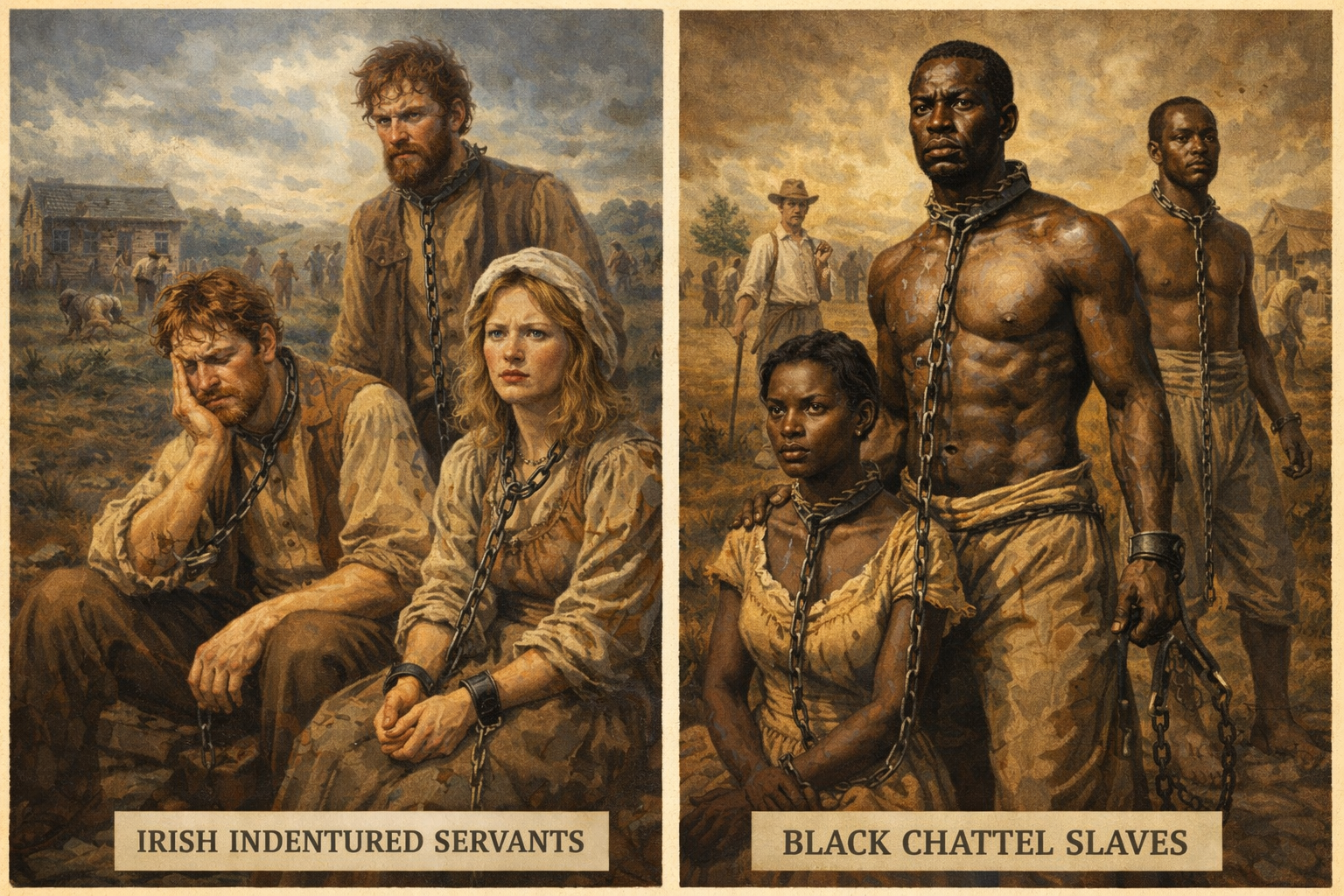
Every so often, a meme or viral post circulates claiming that the Irish were enslaved in the Americas in the same way that Africans were. It’s one of the biggest historical distortions I see repeated online. The idea that “Irish slaves” existed in the same way as African slaves is about as academically credible as the claim that Black Americans are actually Native Americans and not part of the African diaspora (that post will be coming soon).
In other words, the entire premise is built on bad research, misinterpretation, and repetition. When a claim gets repeated often enough within a certain audience, people begin to treat it as fact, even when it collapses under the slightest historical scrutiny.
But let’s entertain the argument for a moment.
Let’s pretend, for the sake of discussion, that Irish people in colonial America were enslaved under conditions as harsh as, or even worse than, those faced by enslaved Africans or descendants of Africans. Even in that hypothetical scenario, the historical outcomes would still be vastly different than the horrific reality that Black slaves endured.
After slavery ended in the United States, Irish immigrants were able to assimilate into the broader category of whiteness after a relatively brief period of northern discrimination against them. This was mostly based on xenophobic ideas rather than strict adherence to a rigid and inhumane racial hierarchy.
Although there was some discrimination against Irish immigrants during much of the latter half of the 19th century and the early 20th century, there were no “Irish Codes” modeled after the Black Codes. There were no Jim Crow laws designed to keep Irish Americans segregated. There were only a relatively few systematic housing policies designed to prevent Irish people from living in certain neighborhoods, and no widespread legal restrictions prevented them from entering particular professions.
In fact, Irish Americans quickly became deeply embedded in American civic life. In cities across the country, from Boston to New York to Chicago, Irish Americans filled municipal jobs, political offices, and police departments.
Whatever discrimination the Irish faced as immigrants in the nineteenth century eventually gave way to full incorporation into the American definition of “white.”
The same cannot be said for Black Americans.
Other European immigrant groups—Italians, Poles, and others—also faced discrimination when they first arrived in the United States. Yet over time, most of these groups were absorbed into the dominant white majority. In many cases, they even became participants in the same social and political systems that marginalized Black Americans.
This is a crucial aspect of the historical narrative that is often overlooked.
The uncomfortable truth is that many Europeans, including the Irish, participated in systems that upheld slavery and racial hierarchy. Irish immigrants were not merely victims of history. Many were slaveholders in the Caribbean, plantation overseers, or participants in slave-catching systems within the United States.
The New York Draft Riots of 1863 offer a stark example of this tension. Irish immigrants in New York violently resisted being drafted to fight in the Civil War, and many of those riots turned into attacks against Black residents of the city. It would make little sense for Irish rioters to protest a war that was supposedly freeing “Irish slaves.” They understood perfectly well to whom slavery applied in America.
And the reality was simple: slavery in the United States was overwhelmingly imposed on Black people.
Some people feel compelled to rewrite history to minimize that fact. But arguments built on historical distortions ultimately collapse under their own weight. When people attempt to counter the legacy of slavery with myths, they end up strengthening the very grievances they are trying to dismiss.
So let’s state the truth and the historical record clearly.
- Irish Americans ultimately assimilated into the broader category of whiteness and were able to participate fully in American society by the early to mid-20th century.
- The system of American slavery became explicitly racial because race made it easier to identify who could be enslaved and who could not.
- The legacy of chattel slavery, followed by Jim Crow, segregation, and institutional discrimination, continues to shape American society today. There is no such legacy connected with the mistreatment of Irish immigrants.
- When Black Americans discuss slavery, we are not asking for pity or charity. What we are demanding is full participation in American society without harassment, stigma, or the expectation that we must hide parts of ourselves to be accepted.
History is complicated. But it becomes even more complicated when people intentionally distort it for political convenience or to escape collective culpability.
The truth is difficult enough without myths getting in the way. And lying about and/or omitting history will not shield the guilty from accountability.