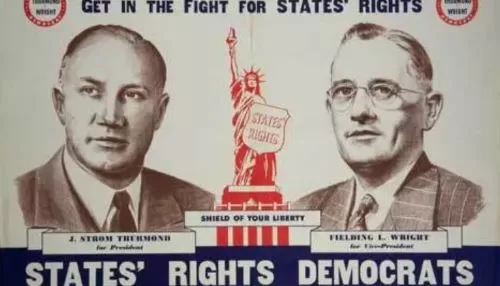
One of the most uncomfortable facts in American political history is that the party alignments of the Jim Crow era no longer resemble the political landscape we see today.
During the late nineteenth and early twentieth centuries, most white voters in the South identified with the Democratic Party. The Democratic Party of that era included the segregationist political leadership that dominated Southern politics during the Jim Crow period.
That began to change in the mid-twentieth century.
After the passage of the Civil Rights Act of 1964, the Voting Rights Act of 1965, and the Fair Housing Act of 1968 (landmark laws supported and signed by Democratic leadership), the political map of the United States gradually shifted. Over the following decades, many white Southern voters moved toward the Republican Party, while Black voters overwhelmingly aligned with the Democratic Party.
This shift did not happen overnight, but the trend is well documented in voting patterns from the late 1960s onward.
These voting patterns are measurable realities, even if they make people uncomfortable.
At the same time, discussions about race in the United States often provoke strong reactions. Many Americans reject the idea that racial attitudes still influence political behavior. Others argue that the issue is not simply politics, but broader patterns of social separation.
Sociologists have long observed that Americans often feel more comfortable within communities that resemble themselves culturally or demographically. Neighborhood patterns, school demographics, and social networks frequently reflect those tendencies.
The result is a society that remains more segregated in practice than many people are willing to acknowledge.
When people point out these patterns, the conversation often becomes heated. Accusations of racism are exchanged, defensiveness rises, and productive discussion becomes difficult.
But acknowledging uncomfortable realities does not make those realities disappear.
If Americans want to have honest conversations about race, politics, and social trust, then those conversations must be grounded in evidence rather than denial. Voting patterns, historical developments, and lived experiences all contribute to understanding the country we live in today.
Ignoring those realities may feel easier in the moment, but it does little to address the underlying tensions that continue to shape American political life.
Leave a Reply