Tag: slavery

  • Africa Is Not One People… And That Changes How We Should Think About Slavery, Identity, and Pan-Africanism

    Africa Is Not One People… And That Changes How We Should Think About Slavery, Identity, and Pan-Africanism

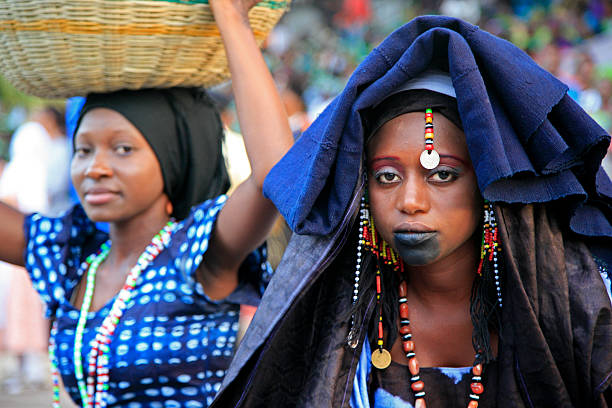
    A picture of Fulani women from iStock. The women have blue traditional garb, makeup, and Fulani jewelry and braids with headdresses on.
    Fulani women wearing traditional garb.

    One of the biggest lessons I keep learning while in Africa is something uncomfortable, but necessary to understand:

    In a deeply twisted way, chattel slavery and apartheid in the Western world helped force Africans in the diaspora into a single racialized identity.

    The “Black” identity became politically real and socially unavoidable in the Americas and much of Europe. But Africa itself did not historically evolve around that kind of singular identity. And if we are serious about understanding African history, slavery, and even Pan-Africanism, we have to start there.
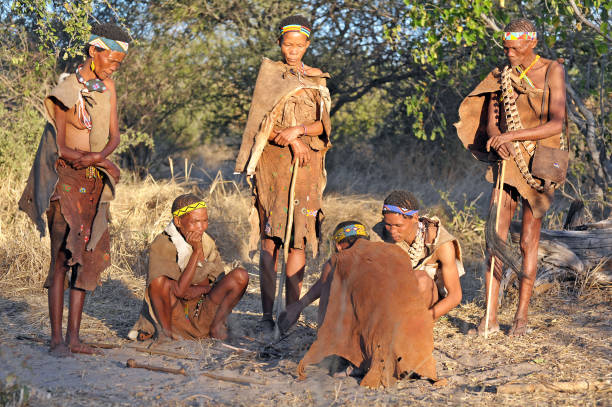
    A group of San people. Some of them are standing. Some are sitting on the ground.
    San bush people gather in the setting sun, Makgadikgadi Pans, Botswana, Southern Africa. The San are an ancient indigenous tribal people who inhabited much of southern Africa, and although few in number today remain proud of their culture, ancestry, and traditional ways of dress, customs, and behaviour that included subsistence hunting and foraging

    Africa Is Not a Monolith

    Africa is the most ethnically and genetically diverse continent on Earth. That matters more than most people realize.

    Many people outside the continent talk about “Africans” as if they are one people who are arbitrarily divided by colonial borders. But that is not really how Africa works. Across the continent, and even within individual countries, there exist many different ethnic groups with their own languages, cultures, religious traditions, histories, and political identities.
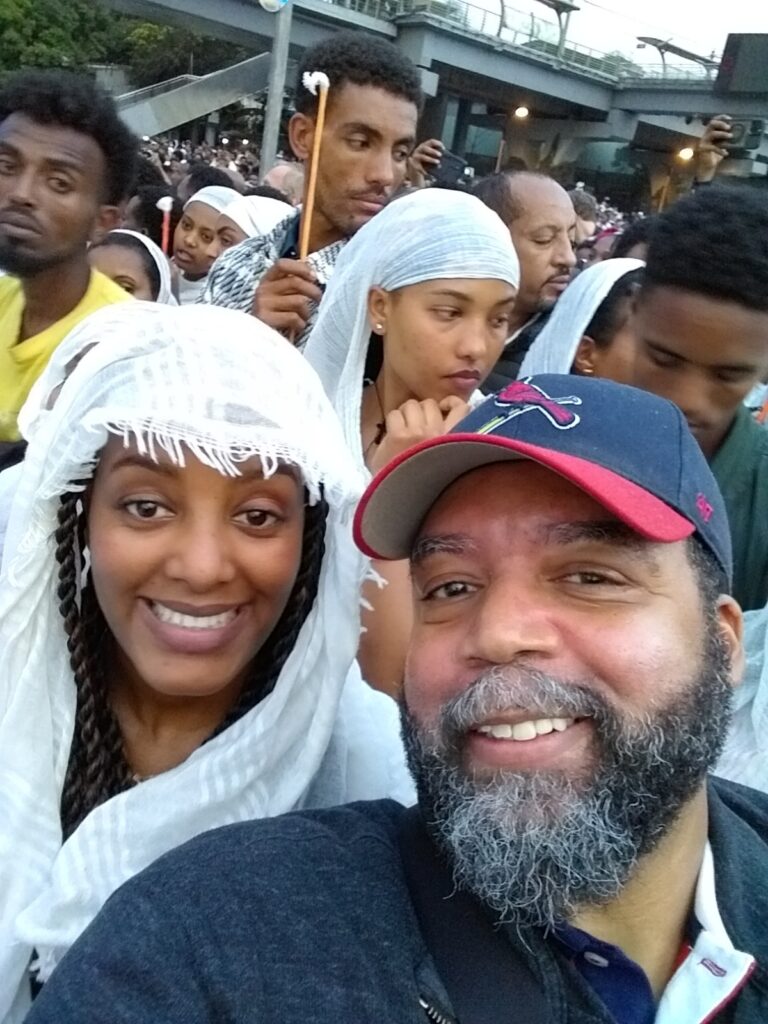
    A selfie taken at the Meskel celebration with my fiance.
    A picture of me and my fiancé at the Meskel festival in Addis Ababa, Ethiopia.

    Take Ethiopia as an example. To outsiders, they are all simply “Ethiopian.” But within Ethiopia, people may identify first as Oromo, Tigray, Amhara, Afar, or something else entirely. Those identities are not cosmetic. They are rooted in deep histories, sometimes cooperation, sometimes rivalry, and sometimes conquest. These groups have their own languages, cultures, and histories that may seem similar to outsiders but are very distinct to Ethiopians themselves.
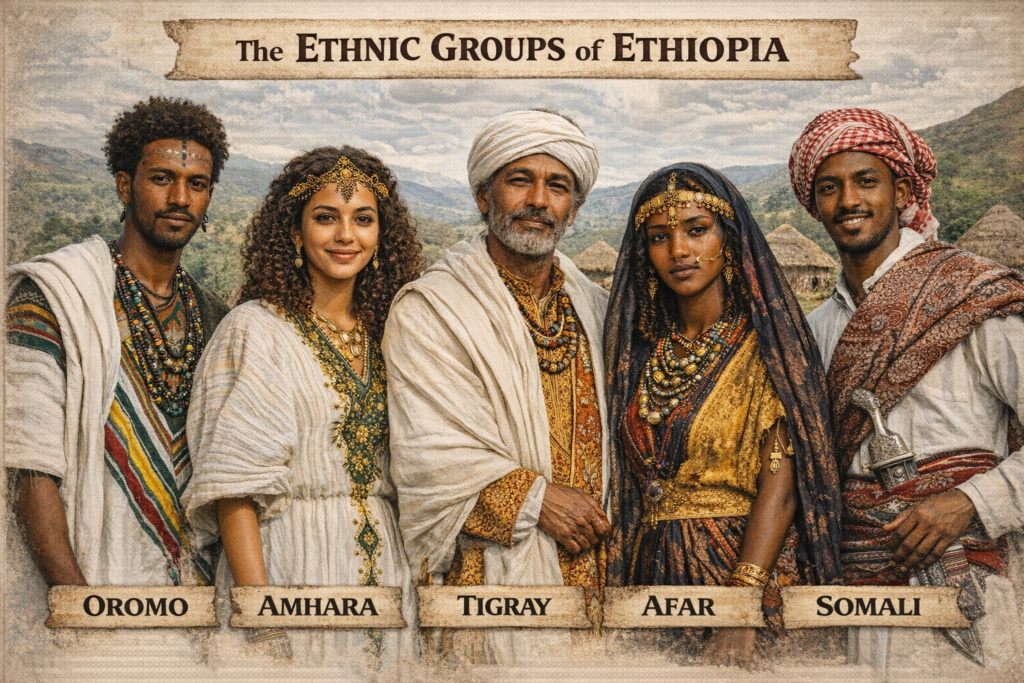
    An AI generated image comparing the different ethnicities of Ethiopia.
    Some of the ethnicities in Ethiopia.

    That is one reason why the question, “Why did Africans sell their own people into slavery?” is often framed misleadingly.

    In many cases, they did not see the people they were selling as “their own people” in the way we mean that phrase today. That doesn’t excuse it morally, but it does make it historically legible.

    A Weird Thought Experiment as a Comparison
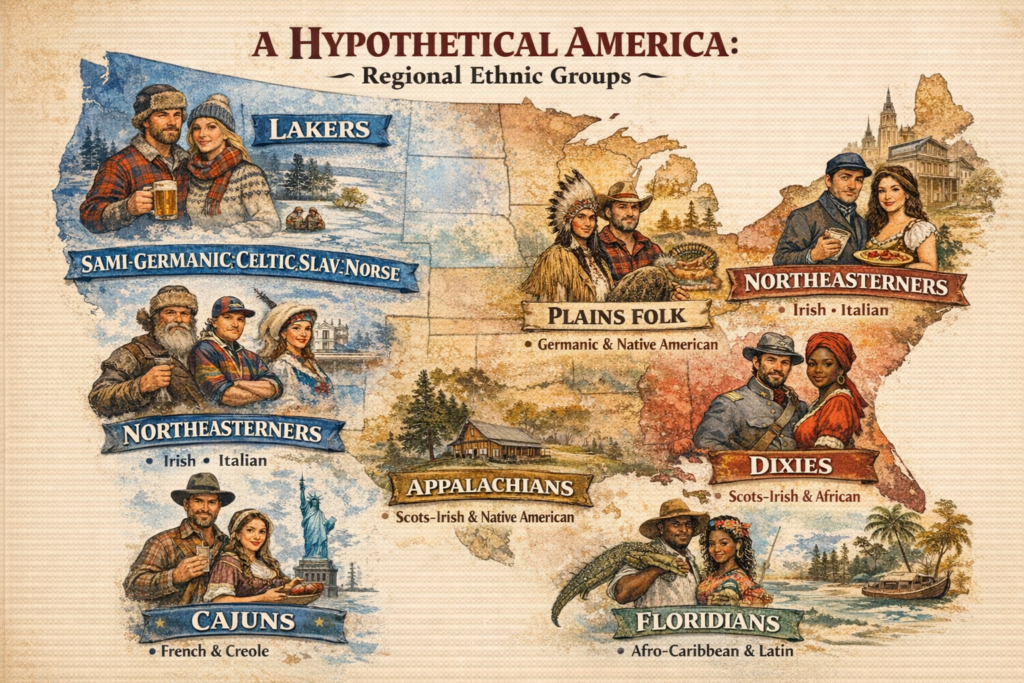
    An AI generated picture with different hypothetical ethnicities of people on a map of the mainland United States.
    A relatively small number of the hypothetical American ethnicities in my thought experiment. These are the different people I imagined if the current makeup of the United States were allowed to develop separately for a long period of time.

    Let’s imagine that the United States is much older than it is. Let’s, in turn, imagine that each region was able to evolve in some isolation for a long time. The Californians will have a different culture and possibly a different language from the Cajuns, the Appalachians, the Lakers to the North, the Dixies, the Floridians, the Plains Folk, the Northeasterners, etc.

    Even right now, with all of us identifying as “American”, except with a hyphenated race identifying prefix, we are different people regionally, with different political ideologies.

    The Dixies (the people of the Deep South) have ALWAYS been very conservative, religious, and loyal to hierarchical systems, whether it was ruled by Republicans, Democrats, Whigs, Democratic-Republicans, Federalists, Loyalists, or whatever party or faction.

    This is different than the Lakers of the eastern parts of the upper Midwest (from Michigan to Minnesota). The Lakers have always been more liberal, regardless of their political party allegiance.

    Lakers and Dixies are different.
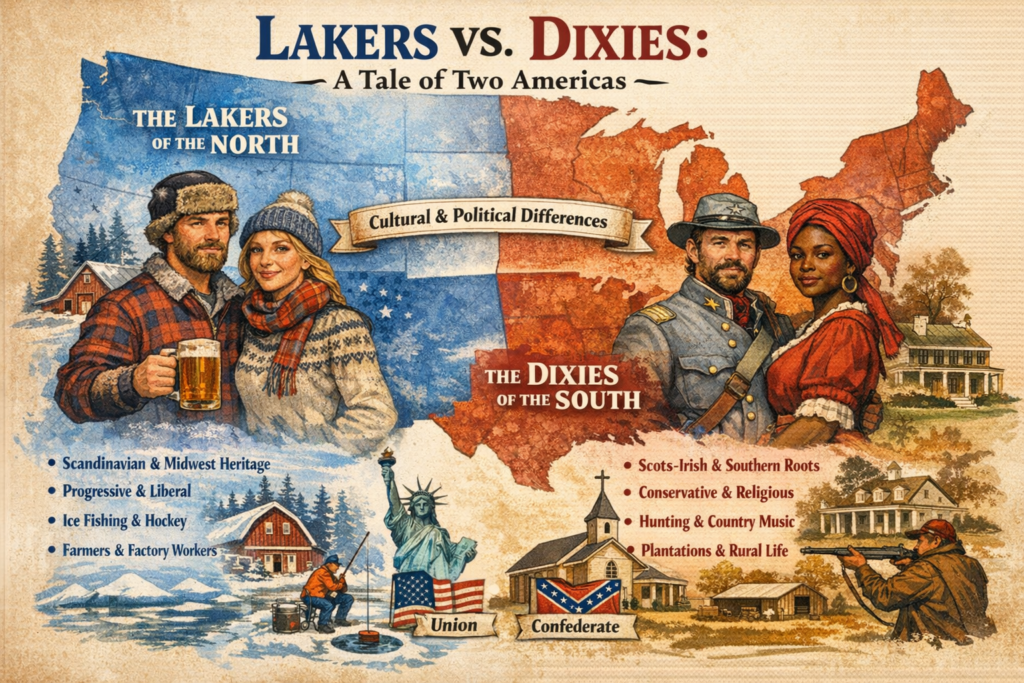
    An AI generated picture highlighting the differences of the Lakers and the Dixies.
    The Lakers and the Dixies are different people in this thought experiment, but their attitudes and sentiments come from reality.

    Dixies are the descendants of Scots, Irish, Africans, and Native Americans. Lakers are the descendants of Scandinavians, the French, and Native Americans.

    Please keep in mind that this is a weird thought experiment to explain African sentiment.

    If the Dixies and Lakers were separated by up to 300K years and have evolved their own languages and customs, then why should we expect them to think of each other as “one people?” If the Dixies and Lakers are different now after only 250 years. Imagine how different they would be after 500 years, 1000 years, 10K years, 50K years, 70K years, 100K years, 150K years, and 300K years. And naturally, the Lakers and Dixies will branch into smaller subgroups and so forth.

    A Better Comparison

    A better comparison would be asking:

    • Why did the Greeks enslave the Macedonians?
    • Why did Spartans dominate Athenians?
    • Why did rival European peoples conquer one another for centuries?

    The answer is simple: they did not see themselves as one people.

    That is much closer to how many African societies historically understood themselves. Ethnicity, kinship, language, and political allegiance mattered more than some broad racial solidarity that would only become more meaningful later under European domination.

    What Slavery and White Supremacy Changed

    For Black people in the diaspora, however, the story was very different.

    In the United States, especially, people of African descent were stripped of their original ethnic identities and grouped into a single racial caste. Whether your ancestors were Igbo, Wolof, Mende, Akan, Kongo, or something else became socially irrelevant in a white supremacist society that only saw one category: Black.

    That process was violent, dehumanizing, and catastrophic.

    But it also produced a single peoplehood forged through oppression. This is something new.

    Black Americans today may have major internal cultural differences, such as Gullah, Creole, Black Midwesterners, Black Southerners, Black Northeasterners, and so on. However, we are still socially treated as one people. In that sense, our race had become our ethnicity and historical/cultural marker.
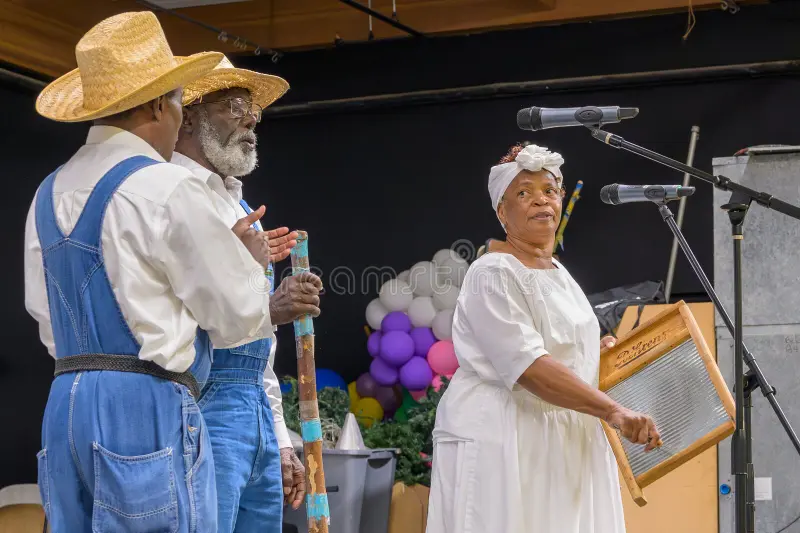
    A royalty free image from Dreamstime of Gullah.
    The Gullah people.

    Africa and the Diaspora Are Related, But Not the Same

    That is part of what makes the relationship between continental Africans and the diaspora so complicated.

    We are connected by ancestry, by history, and by racialization in a white-dominated world. But we are not simply interchangeable. Africans are not automatically “us,” and we are not automatically “them,” at least not in a cultural or ethnic sense.

    That doesn’t mean the connection is fake. It means the connection has to be understood honestly.

    This is the same for Black Americans, Black Canadians, Black Jamaicans, Afro-Latinos, and other Diasporans. We’ve been separated long enough to have different cultures, different linguistic rules, and different sets of values.

    And that honesty matters because it opens the door to a more mature version of Pan-Africanism based not on fantasy, but on political solidarity.

    The Future of Pan-Africanism
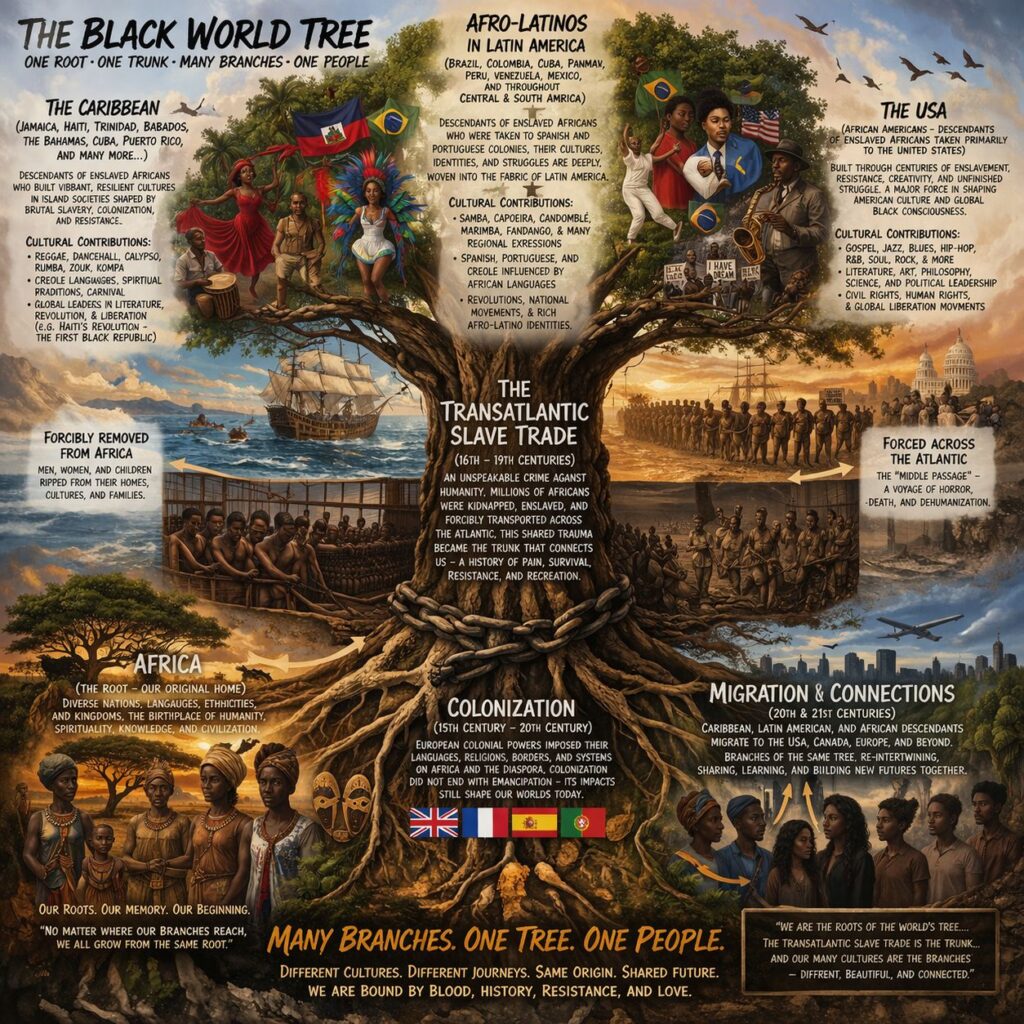
    An AI image of the African Diaspora represented by a tree.
    The Black World Tree by Dike Obioma Matthew. He had permitted me to use this image on my blog. In this, he makes the Trans-Atlantic Slave Trade the Trunk of the tree uniting the people of many different roots before they are branched off.

    The encouraging thing is that many Africans and people across the diaspora are increasingly embracing a broader consciousness.

    More and more people are beginning to see that, whatever their ethnic or national differences, they share a common struggle against White supremacy, neocolonialism, extraction, and domination.

    In that sense, Pan-Africanism is not about pretending all Black people are the same. We are not. But neither are White people nor Asians.

    It is about recognizing that we do not have to be the same to fight for one another.

    That is the challenge and the promise.

    Africa does not need to dominate the world. Neither does the diaspora.

    The goal is about something much more meaningful than some bullshit race to the top.

    Our goal is about self-determination, dignity, cooperation, and the power to shape our own destiny without the aid, supervision, or permission of powerful developed countries run by those of European or Asian descent.
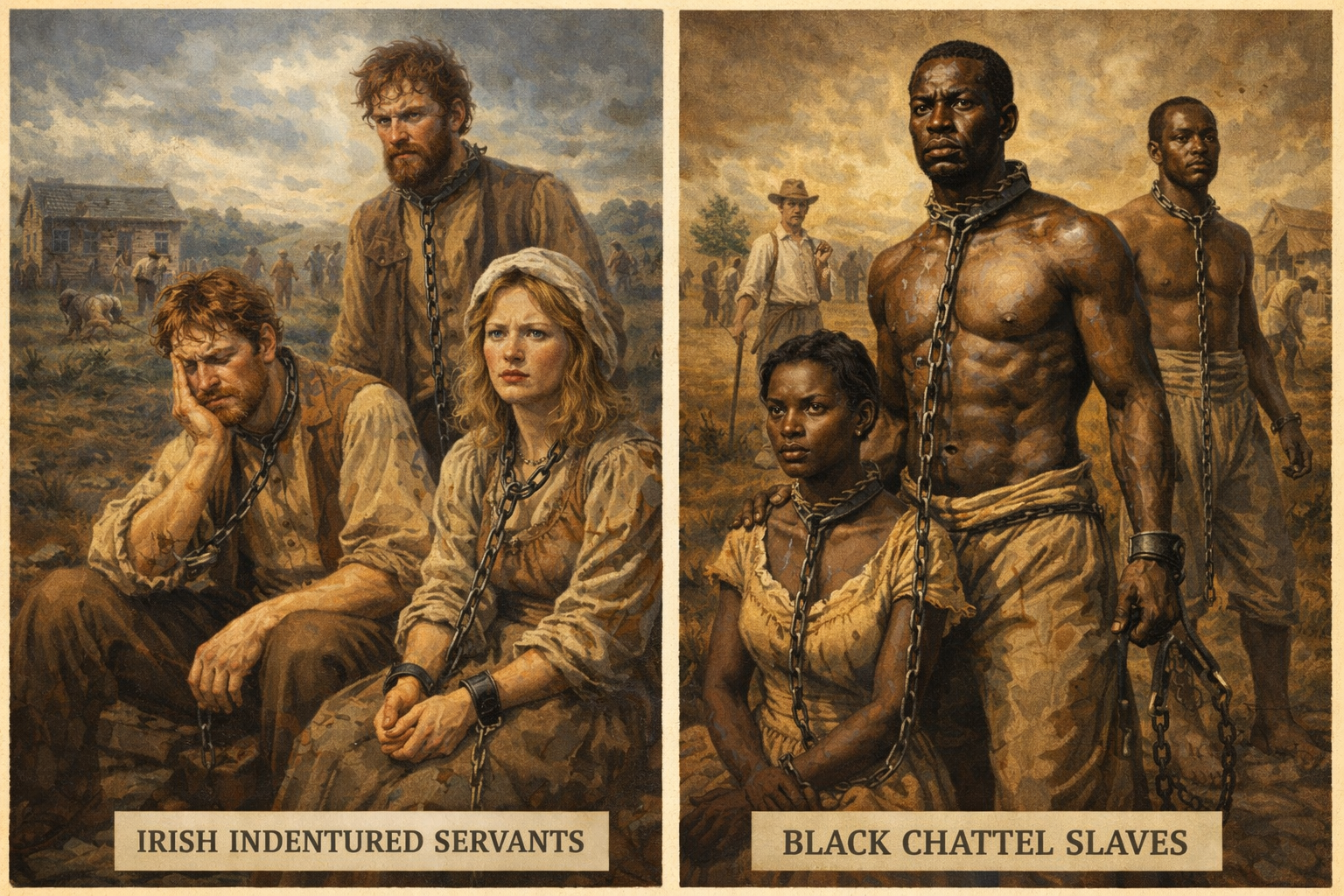
  • American History Myths #7:The Myth of “Irish Slavery” and the Politics of Bad History

    American History Myths #7:The Myth of “Irish Slavery” and the Politics of Bad History

    Every so often, a meme or viral post circulates claiming that the Irish were enslaved in the Americas in the same way that Africans were. It’s one of the biggest historical distortions I see repeated online. The idea that “Irish slaves” existed in the same way as African slaves is about as academically credible as the claim that Black Americans are actually Native Americans and not part of the African diaspora (that post will be coming soon).

    In other words, the entire premise is built on bad research, misinterpretation, and repetition. When a claim gets repeated often enough within a certain audience, people begin to treat it as fact, even when it collapses under the slightest historical scrutiny.

    But let’s entertain the argument for a moment.

    Let’s pretend, for the sake of discussion, that Irish people in colonial America were enslaved under conditions as harsh as, or even worse than, those faced by enslaved Africans or descendants of Africans. Even in that hypothetical scenario, the historical outcomes would still be vastly different than the horrific reality that Black slaves endured.

    After slavery ended in the United States, Irish immigrants were able to assimilate into the broader category of whiteness after a relatively brief period of northern discrimination against them. This was mostly based on xenophobic ideas rather than strict adherence to a rigid and inhumane racial hierarchy.

    Although there was some discrimination against Irish immigrants during much of the latter half of the 19th century and the early 20th century, there were no “Irish Codes” modeled after the Black Codes. There were no Jim Crow laws designed to keep Irish Americans segregated. There were only a relatively few systematic housing policies designed to prevent Irish people from living in certain neighborhoods, and no widespread legal restrictions prevented them from entering particular professions.

    In fact, Irish Americans quickly became deeply embedded in American civic life. In cities across the country, from Boston to New York to Chicago, Irish Americans filled municipal jobs, political offices, and police departments.

    Whatever discrimination the Irish faced as immigrants in the nineteenth century eventually gave way to full incorporation into the American definition of “white.”

    The same cannot be said for Black Americans.

    Other European immigrant groups—Italians, Poles, and others—also faced discrimination when they first arrived in the United States. Yet over time, most of these groups were absorbed into the dominant white majority. In many cases, they even became participants in the same social and political systems that marginalized Black Americans.

    This is a crucial aspect of the historical narrative that is often overlooked.

    The uncomfortable truth is that many Europeans, including the Irish, participated in systems that upheld slavery and racial hierarchy. Irish immigrants were not merely victims of history. Many were slaveholders in the Caribbean, plantation overseers, or participants in slave-catching systems within the United States.

    The New York Draft Riots of 1863 offer a stark example of this tension. Irish immigrants in New York violently resisted being drafted to fight in the Civil War, and many of those riots turned into attacks against Black residents of the city. It would make little sense for Irish rioters to protest a war that was supposedly freeing “Irish slaves.” They understood perfectly well to whom slavery applied in America.

    And the reality was simple: slavery in the United States was overwhelmingly imposed on Black people.

    Some people feel compelled to rewrite history to minimize that fact. But arguments built on historical distortions ultimately collapse under their own weight. When people attempt to counter the legacy of slavery with myths, they end up strengthening the very grievances they are trying to dismiss.

    So let’s state the truth and the historical record clearly.

    • Irish Americans ultimately assimilated into the broader category of whiteness and were able to participate fully in American society by the early to mid-20th century.
    • The system of American slavery became explicitly racial because race made it easier to identify who could be enslaved and who could not.
    • The legacy of chattel slavery, followed by Jim Crow, segregation, and institutional discrimination, continues to shape American society today. There is no such legacy connected with the mistreatment of Irish immigrants.
    • When Black Americans discuss slavery, we are not asking for pity or charity. What we are demanding is full participation in American society without harassment, stigma, or the expectation that we must hide parts of ourselves to be accepted.

    History is complicated. But it becomes even more complicated when people intentionally distort it for political convenience or to escape collective culpability.

    The truth is difficult enough without myths getting in the way. And lying about and/or omitting history will not shield the guilty from accountability.

  • Nathan Bedford Forrest and the Possibility of Change

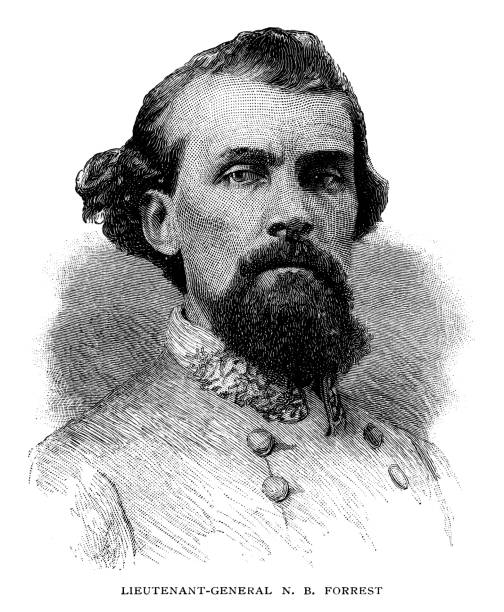
    Nathan Bedford Forrest and the Possibility of Change

    Nathan Bedford Forrest remains one of the most controversial figures of the American Civil War.

    To many white Southerners, he is remembered as a brilliant cavalry commander and military tactician who rose from poverty to become one of the most effective battlefield leaders of the Confederacy.

    To many others—especially Black Americans—he is remembered as something very different: a former slave trader, a Confederate general associated with the Fort Pillow massacre, and the first Grand Wizard of the Ku Klux Klan.

    Both of these perspectives capture parts of the historical record.

    Before the Civil War, Forrest built a fortune as a slave trader, cotton planter, and livestock dealer. During the war, he became famous for his aggressive cavalry tactics and battlefield success. After the war, he was deeply involved in the early Ku Klux Klan, an organization that used violence and intimidation against newly freed Black Americans and their allies during Reconstruction.

    That part of his legacy is undeniable.

    What is less commonly discussed, however, are the statements Forrest made later in his life. By the 1870s, he publicly distanced himself from the Ku Klux Klan and reportedly called for its disbandment. In 1875, he delivered a speech to a Black civic organization in Memphis in which he encouraged reconciliation and cooperation between Black and white Southerners.

    Historians continue to debate what these actions meant.

    Some believe Forrest experienced a genuine change of heart late in life. Others argue that his statements were politically motivated during a turbulent Reconstruction period.

    What is clear is that Forrest’s life illustrates the uncomfortable complexity of history.

    He was undeniably involved in some of the most brutal systems of racial oppression in American history. At the same time, his later statements suggest at least some recognition—whether moral, political, or pragmatic—that the future of the South required a different path.

    That complexity is often lost in modern debates.

    Some defenders of Confederate memory celebrate Forrest primarily as a military hero while ignoring the racism and violence that defined much of his career. Others reduce him entirely to the worst aspects of his life without acknowledging the possibility—however limited or contested—that his views evolved later on.

    History rarely fits into simple moral categories.

    Studying figures like Nathan Bedford Forrest should not be about glorification or absolution. It should be about understanding how people, institutions, and societies change—and sometimes fail to change—over time.

  • Faith, Poverty, and the Problem of Suffering

    Faith, Poverty, and the Problem of Suffering

    One thing that has always puzzled me is how deeply religious many of the most desperate people in the world tend to be.

    In many parts of the Global South, countries dealing with poverty, political instability, civil wars, or ethnic violence, religion often plays an enormous role in everyday life. The same pattern appears in many impoverished communities in the United States as well, including historically marginalized Black communities.

    At first glance, that seems counterintuitive.

    You might expect that people living under the harshest conditions would be the most likely to question the existence of a loving and powerful deity. After all, if a God exists who is both omnipotent (all-powerful) and omnibenevolent (all-loving), why would so many of the people who pray to that God be trapped in poverty, violence, and instability?

    Philosophers have asked versions of that question for centuries.

    It is sometimes called the Problem of Evil: if God is all-powerful, all-knowing, and all-loving, why does suffering exist at such a massive scale?

    This question becomes especially difficult when we look at the distribution of suffering in the world. Many of the most devout populations live in places where resources are scarce, healthcare is limited, life expectancy is lower, and political systems are unstable. Meanwhile, many of the wealthiest and most secure societies on earth are becoming increasingly secular.

    That contrast raises uncomfortable questions.

    Why would a loving deity allow the most faithful believers to live under the harshest conditions? Why are so many people who pray daily still forced to struggle for necessities like food, clean water, medical care, and safety?

    Believers have offered many answers. Some argue that suffering is part of a divine plan. Others say it results from human free will, corruption, or the brokenness of the world. Some suggest that faith provides psychological strength that helps people endure hardship.

    But for skeptics and atheists like me, these explanations often feel unsatisfying.

    From a secular perspective, religion can sometimes appear less like a response to evidence and more like a coping mechanism. It becomes something that provides emotional comfort in situations where people have little control over their circumstances.

    Despite this, I understand the need for people to seek the hope of religion… at lest on a purely psychological level.

    Human beings have always created systems of meaning to help them survive hardship. Faith can offer community, hope, and psychological resilience in environments where those things are desperately needed. I get that.

    But still, the philosophical tension remains.

    If suffering is widespread, persistent, and often falls hardest on those who are already vulnerable, it raises difficult questions about the nature, or even the existence, of an ominbelevolent, ominscient, omipresent, and omnipotent supreme supernatural being.

    For many atheists, that tension is one of the reasons belief becomes difficult to maintain.

    Not because we dislike religion or want to antagonize believers… well, at least not me… most of the time, but because the world itself often appears incompatible with the idea of a benevolent and actively intervening deity, especially in many of the most religious countries.

  • Why I Still Celebrate Independence Day

    Why I Still Celebrate Independence Day

    Every year on July 4th, Americans celebrate Independence Day with family gatherings, barbecues, and fireworks. For many, it is a day of patriotic pride, a celebration of freedom and the sacrifices made to preserve it.

    But for others, the holiday carries a very different meaning.

    Frederick Douglass once famously asked, “What to the slave is the Fourth of July?” In 1852, his answer was clear: the holiday represented a painful contradiction between America’s ideals and its reality. More than a century later, that question still echoes—but the answer has evolved.

    Critics of Independence Day often point out a painful historical truth: when the United States declared its independence in 1776, the promise of liberty did not apply to everyone. Millions of people were enslaved, Native Americans were being displaced and killed, and women and poor men were excluded from political power.

    The contradiction is obvious.

    The same document that declared, “We hold these truths to be self-evident, that all men are created equal,” was written by Thomas Jefferson, who owned slaves and wrote extensively about his belief in Black inferiority.

    These criticisms are not wrong. They are historically accurate.

    The freedom celebrated on July 4th was originally intended primarily for land-owning white men. Black Americans, Native Americans, women, and many others were excluded from those rights.

    Even during the Revolutionary War, enslaved Black people who sought to fight for the American colonies were often rejected. Meanwhile, the British offered freedom to enslaved people who joined their forces. Later, during the Constitutional Convention, the young nation again refused to confront slavery to maintain unity between Northern and Southern states.

    For these reasons, I understand why some people view Independence Day with skepticism or even contempt.

    But while I sympathize with that perspective, I do not share it.

    Despite the hypocrisy of many of the Founding Fathers, we must also remember another truth: this country was built in large part by the labor, skill, and resilience of enslaved Black people.

    The American colonies became economically powerful through crops such as tobacco, sugar, and rice. These industries made their overwhelming prosperity possible by enslaved labor and agricultural knowledge brought from Africa. In many ways, the wealth that allowed the colonies to rebel against Britain was created by the very people who were denied freedom.

    Our ancestors helped build this country.

    And many of them knew it.

    Throughout the nineteenth century, some white abolitionists supported efforts to relocate free Black Americans to Africa through organizations such as the American Colonization Society. Liberia itself was founded by freed American slaves.

    But many Black Americans rejected that idea. They chose to remain in the United States and fight for their rightful place within the country their ancestors had helped build.

    That is a perspective I share.

    If someone kidnaps you, forces you to build a house, and then tells you that you are free to leave once the work is finished, that does not erase the fact that you helped build the house.

    You have a claim to it.

    I am an American. This is my country.

    The personal beliefs of many of the Founding Fathers matter less to me than the political framework they created. The words they wrote, however imperfectly applied at the time, provided the foundation for later struggles for freedom.

    The ideals expressed in the Declaration of Independence and the United States Constitution were eventually used by abolitionists, civil rights leaders, and countless activists to argue that the nation must live up to its own principles.

    Jefferson may not have meant all people when he wrote that all men are created equal. But that is what he wrote, and those words became powerful tools in the fight for equality.

    The American political system, flawed as it has been, allowed movements for abolition, civil rights, and expanded democratic rights to emerge and reshape the country.

    The fact that I can speak freely today (even critically) about the history and institutions of this country is evidence of that evolution.

    Because of the protections enshrined in the Constitution and the Bill of Rights, I can express my beliefs, criticize injustice, and advocate for change without fear of imprisonment or execution.

    That freedom matters.

    So, when I celebrate Independence Day, I am not celebrating the perfection of the Founding Fathers. I am not celebrating a past that excluded my ancestors.

    What I celebrate is freedom itself.

    The freedom that was denied to my ancestors.

    The freedom that generations of Americans struggled to expand.

    The freedom that remains imperfect, but real.

    This country has a painful history, and it still faces serious challenges. But it is also my home.

    And despite everything, I love it.

    When I celebrate Independence Day, I celebrate the ongoing struggle to make the promise of liberty real for everyone.

    Because the words written in 1776 still matter:

    “We hold these truths to be self-evident, that all men are created equal, that they are endowed by their Creator with certain unalienable Rights, that among these are Life, Liberty and the pursuit of Happiness.”

    May we continue working toward a country where those words apply to all of us.

  • American History Myth #1: The “2% of Whites Owned Slaves” Myth

    American History Myth #1: The “2% of Whites Owned Slaves” Myth

    How misleading statistics distort the history of American slavery

    One of the most commonly repeated talking points in discussions about American slavery is the claim that “only about 2% of white Americans owned slaves.” Technically, the statistic isn’t entirely false. Historical records show that roughly 1.4% of white Americans were listed as the legal owners of enslaved people in 1860.

    But that statistic is also deeply misleading.

    The problem is that slave ownership was not simply an individual arrangement. It was a household institution. When a person legally owned enslaved people, everyone in that household benefited from and exercised authority over them. A slave owned by the father of a family was effectively under the control of the entire household: the wife, the children, and anyone else living on that property.

    This is the same reason that car ownership statistics in the United States are often measured by households rather than by individuals. A car may be registered in one person’s name, but the entire household typically has access to it.

    When historians measure slave ownership by households rather than individuals, the numbers change dramatically.

    By 1860, nearly 10% of all white families in the United States owned enslaved people.

    The concentration of slave ownership in the South makes the numbers even more striking. In that same year:

    • About 25% of white families in the South owned slaves.
    • In the states that would form the Confederacy, the number rose to 31%.
    • In South Carolina, approximately 46% of white families owned enslaved people.
    • In Mississippi, the number was roughly 49%.

    These figures reveal that slavery was not an obscure or marginal institution. In many parts of the South, it was a central feature of society.

    And even these numbers do not fully capture the scale of the system.

    The entire Southern economy was built around slavery. Many people who did not personally own enslaved individuals still profited from the institution. Slave catchers were paid to hunt down escaped slaves. Blacksmiths manufactured shackles and restraints. Insurance companies sold policies on enslaved people as property. Enslaved laborers were often rented out to families or businesses that did not technically own them.

    The percentage of white households that benefited economically from slavery was almost certainly much higher than the percentage that legally owned enslaved people.

    So why does the “2% statistic” get repeated so often?

    Because it serves a political purpose.

    In many contemporary debates about race and history, some commentators attempt to minimize the responsibility of white Americans for the system of chattel slavery. They frequently redirect attention toward African kingdoms that participated in the transatlantic slave trade, or they argue that slavery existed throughout the world, implying that American slavery was not particularly unique.

    But chattel slavery in the Western Hemisphere was fundamentally different from many earlier forms of slavery. It was racialized, hereditary, and legally defined as permanent property ownership over human beings.

    Another frequently overlooked fact is that the vast majority of enslaved people in the United States were not directly imported from Africa.

    By the nineteenth century, most enslaved people in the United States had been born into slavery within the country itself. Historians estimate that only about 4–6% of enslaved people in the history of the United States were directly imported from Africa. By 1860, the overwhelming majority of enslaved people were the descendants of earlier enslaved populations.

    This means that the American slave system was sustained largely through the forced reproduction and exploitation of enslaved families within the United States.

    None of this means that every white American owned slaves. In 1860, there were 33 states in the United States, and slavery was legal in only 15 of them. Many white Americans lived in free states or did not own land or enslaved laborers.

    But minimizing the scale of slavery—or the extent of public support for it—distorts the historical record.

    Slavery persisted not simply because of a small group of wealthy plantation owners, but because large segments of Southern society supported and defended the institution politically, economically, and culturally.

    Even families who did not personally own enslaved people could still support slavery by voting for pro-slavery politicians, working in industries that sustained the slave economy, serving as overseers or slave catchers, or fighting for the Confederacy during the Civil War.

    Statistics without context can obscure more than they reveal.

    The claim that “only 2% of whites owned slaves” may sound like an attempt to shrink the scale of responsibility. But when examined more closely, the historical reality shows that slavery was deeply embedded in the social, economic, and political life of the United States.