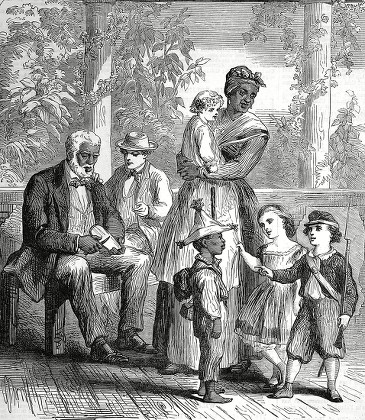
How misleading statistics distort the history of American slavery
One of the most commonly repeated talking points in discussions about American slavery is the claim that “only about 2% of white Americans owned slaves.” Technically, the statistic isn’t entirely false. Historical records show that roughly 1.4% of white Americans were listed as the legal owners of enslaved people in 1860.
But that statistic is also deeply misleading.
The problem is that slave ownership was not simply an individual arrangement. It was a household institution. When a person legally owned enslaved people, everyone in that household benefited from and exercised authority over them. A slave owned by the father of a family was effectively under the control of the entire household: the wife, the children, and anyone else living on that property.
This is the same reason that car ownership statistics in the United States are often measured by households rather than by individuals. A car may be registered in one person’s name, but the entire household typically has access to it.
When historians measure slave ownership by households rather than individuals, the numbers change dramatically.
By 1860, nearly 10% of all white families in the United States owned enslaved people.
The concentration of slave ownership in the South makes the numbers even more striking. In that same year:
- About 25% of white families in the South owned slaves.
- In the states that would form the Confederacy, the number rose to 31%.
- In South Carolina, approximately 46% of white families owned enslaved people.
- In Mississippi, the number was roughly 49%.
These figures reveal that slavery was not an obscure or marginal institution. In many parts of the South, it was a central feature of society.
And even these numbers do not fully capture the scale of the system.
The entire Southern economy was built around slavery. Many people who did not personally own enslaved individuals still profited from the institution. Slave catchers were paid to hunt down escaped slaves. Blacksmiths manufactured shackles and restraints. Insurance companies sold policies on enslaved people as property. Enslaved laborers were often rented out to families or businesses that did not technically own them.
The percentage of white households that benefited economically from slavery was almost certainly much higher than the percentage that legally owned enslaved people.
So why does the “2% statistic” get repeated so often?
Because it serves a political purpose.
In many contemporary debates about race and history, some commentators attempt to minimize the responsibility of white Americans for the system of chattel slavery. They frequently redirect attention toward African kingdoms that participated in the transatlantic slave trade, or they argue that slavery existed throughout the world, implying that American slavery was not particularly unique.
But chattel slavery in the Western Hemisphere was fundamentally different from many earlier forms of slavery. It was racialized, hereditary, and legally defined as permanent property ownership over human beings.
Another frequently overlooked fact is that the vast majority of enslaved people in the United States were not directly imported from Africa.
By the nineteenth century, most enslaved people in the United States had been born into slavery within the country itself. Historians estimate that only about 4–6% of enslaved people in the history of the United States were directly imported from Africa. By 1860, the overwhelming majority of enslaved people were the descendants of earlier enslaved populations.
This means that the American slave system was sustained largely through the forced reproduction and exploitation of enslaved families within the United States.
None of this means that every white American owned slaves. In 1860, there were 33 states in the United States, and slavery was legal in only 15 of them. Many white Americans lived in free states or did not own land or enslaved laborers.
But minimizing the scale of slavery—or the extent of public support for it—distorts the historical record.
Slavery persisted not simply because of a small group of wealthy plantation owners, but because large segments of Southern society supported and defended the institution politically, economically, and culturally.
Even families who did not personally own enslaved people could still support slavery by voting for pro-slavery politicians, working in industries that sustained the slave economy, serving as overseers or slave catchers, or fighting for the Confederacy during the Civil War.
Statistics without context can obscure more than they reveal.
The claim that “only 2% of whites owned slaves” may sound like an attempt to shrink the scale of responsibility. But when examined more closely, the historical reality shows that slavery was deeply embedded in the social, economic, and political life of the United States.
Leave a Reply